
Light direction-dependent plasmonic enhanced GaN/AlN quantum cascade detector
2Institute of Condensed Matter Physics, Ecole Polytechnique Fédérale de Lausanne
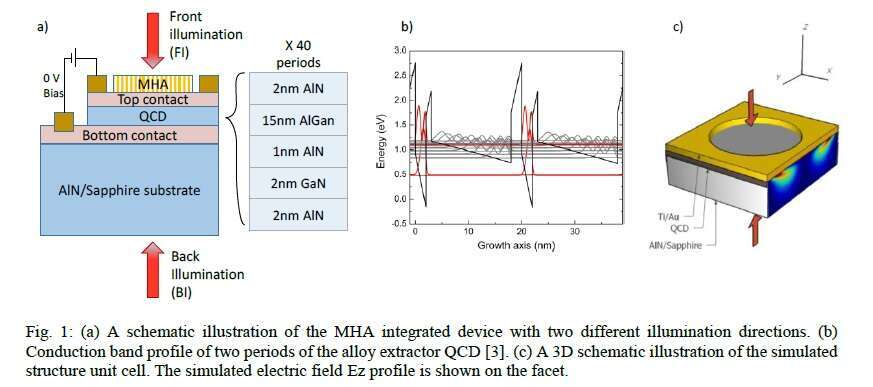
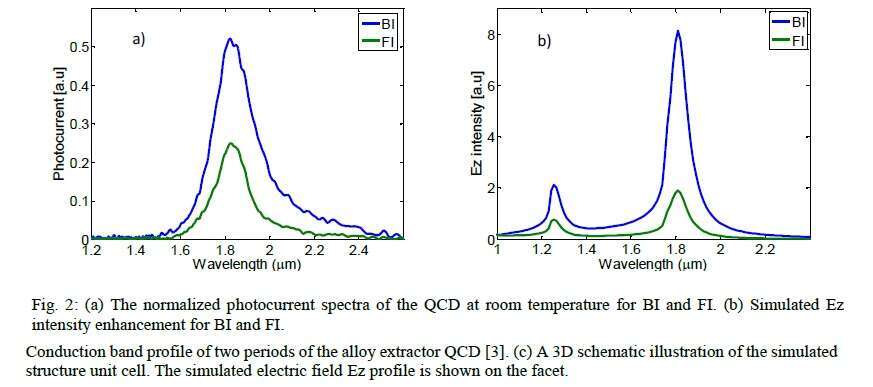
The fundamental building-block of a QCD consists of an active quantum well (QW) where electron excitation occurs upon photon intersubband (ISB) absorption, and multi-quantum well extractor that transfers the excited electron to the ground level of the following active QW. Major drawback of the QCD in applications based on normal light incidence is related to the polarization selection rule of QW inter-subband (ISB) transitions, allowing absorption only for an electric field polarized perpendicular to the QW layers (Ez). The use of two dimmensional metallic holes arrays (MHAs) allows coupling surface plasmons (SP) to absorption region of the QCD. The generated SP is a TM mode thus exhibits a dominant electric field component normal to the surface that is the proper polarization for exciting the ISB resonance. In the present work we show experimentally and by simulation that plasmonic enhancement performance of a QCD integrated with top MHA depends on the direction of the incidence light; normal Front Illumination (FI) or Backside Illumination (BI). In the study, it is shown that BI considerably increases the light coupling strength compared with FI. The peak responsivity is incresead from 1.77 to 2.72 mA/W at 1.82 μm by changing the light direction. For studying the effect of plasmonic Ez field depth decay on QCD performance, further work is being done on a new QCD sample that consists of 3 active periods.
Powered by Eventact EMS