A TRISPYRAZOLYLBORATO IRON CYSTEINATO COMPLEX AS A FUNCTIONAL MODEL FOR THE CYSTEIN DIOXYGENASE
Department of Chemistry, Humboldt-Universität zu Berlin, Berlin
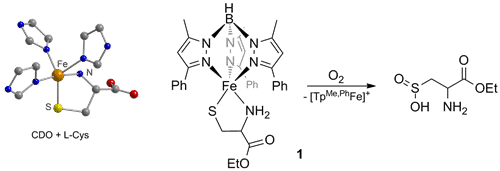
The cysteine dioxygenase (CDO) is a non-heme iron proteine that catalyzes the oxidation of cysteine with molecular oxygen to yield cysteine sulfinic acid, needed for the assembly of central metabolites in the human organism.While the functions of many oxygenating iron enzymes could be successfully imitated within the last decades using molecular model compounds,[1] there are hardly any reports[2] in the literature to date on biomimetic models for the CDO, whose structure is known since 2006 (the structure of the active site after substrate binding is shown below).
Recently, we have been able to develop the complex [TpMe,PhFeCysOEt], 1, which represents an excellent structural and functional replicate of the CDO (see Scheme): 1) The TpMe,Ph ligand excellently mimics the (His)3-coordination sphere of the FeII center, and the cysteine substrate is only slightly modified by esterification; 2) Treatment with O2 leads to dioxygenase activity, as confirmed inter alia by isotopic labeling experiments.[3] 1 therefore represents the hitherto most realistic model for the active site of the CDO and thus an interesting source for the elucidation of structural and mechanistic information on species occurring in the CDO catalytic cycle.
[1] M. Costas, M. P. Mehn, M. P. Jensen, L. Que, Jr., Chem. Rev. 2004, 104, 939; W. Nam, Acc. Chem. Res. 2007, 40, 522; I. Siewert, C. Limberg, Chem. Eur. J. 2009, 15, 10316.
[2] Y. Jiang, L. R. Widger, G. D. Kasper, M. A. Siegler, D. P. Goldberg, J. Am. Chem. Soc. 2010, 132, 12214; A. R. McDonald, M. R. Bukowski, E. R. Farquhar, T. A. Jackson, K. D. Koehntop, M. Sook Seo, R. F. De Hont, A. Stubna, J. A. Halfen, E. Münck, W. Nam, L. Que, Jr., J. Am. Chem. Soc. 2010, 132, 17118.
[3] M. Sallmann, I. Siewert, L. Fohlmeister, C. Limberg, C. Knispel, Angew. Chem. Int. Ed. 2012, 51, 2234.
Powered by Eventact EMS