
Prognostic Implications of Chronic Kidney Disease on Patients Presenting with ST- Segment Elevation Myocardial Infarction with vs. without Stent Thrombosis
Background:
Limited data is present regarding long term outcomes in chronic kidney disease (CKD) patients presenting with stent thrombosis (ST). We evaluated the possible implications of CKD on long term mortality in patients presenting with ST elevation myocardial infarction (STEMI) and treated with primary percutaneous coronary intervention (PCI), and its interaction with the presence of ST.
Methods:
We retrospectively studied 1722 STEMI patients treated by primary PCI. Baseline CKD was categorized as an estimated glomerular filtration rate (eGFR) ≤60 mL/min/1.73m2 at presentation. The presence of ST was determined using the Academic Research Consortium definitions. Patients were evaluated for the presence of CKD and ST, as well as for long term mortality.
Results:
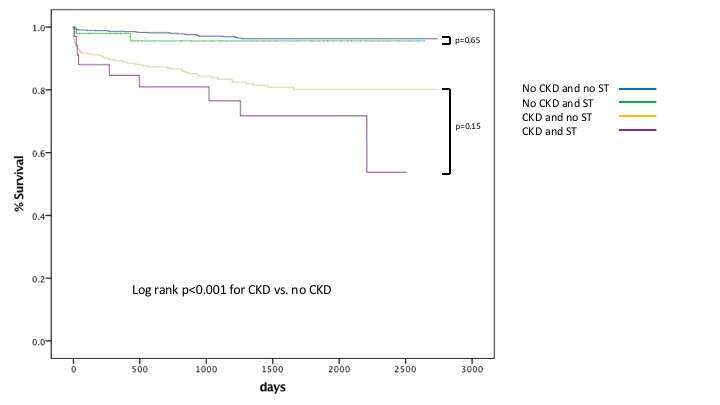
A total of 448/1722 (26%) patients had baseline CKD. Patients with CKD were older, had more comorbidities and higher rate of ST (4% vs. 7% respectively, p<0.001). In a univariate analysis, long term mortality was significantly higher among those with CKD compared to those without CKD (17.6% vs. 2.7%, p<0.001)) The presence of ST did not alter long term mortality in both CKD and no-CKD patients. In a cox regression model, CKD was an independent predictor of long term mortality (HR 2.04, 95% CI 1.17-3.56, P =0.01), while ST as a covariate was not significantly associated with long term mortality.
Conclusion:
Among STEMI patients, CKD, however not ST, is a predictor of long term mortality.
Powered by Eventact EMS