Water-Soluble Manganese Clusters As Electro-Catalysts For Homogeneous Water Splitting
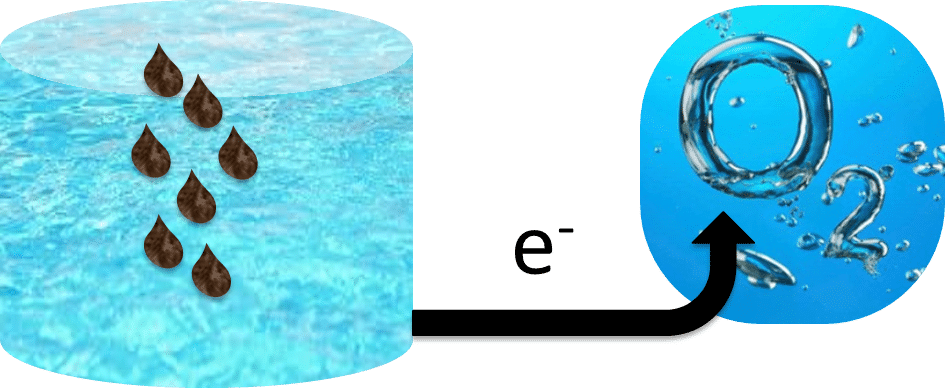
A promising approach in the search of renewable and alternative energy is to mimic nature and develop a system for artificial photosynthesis, which converts water into oxygen and hydrogen. The main and most challenging part is the development of an efficient water oxidation catalyst.
The biological water splitting process takes place at the oxygen-evolving center (OEC) of photosystem II, producing O2, protons and electrons. The OEC is a Metallo-oxo cluster Mn4O5Ca in which Mn oxidation state varies from III to V. This cluster stores four electrons in four successive 1e- oxidation steps, with narrow potential range, followed by the generation O2 and regeneration of the OEC in its initial oxidation state.
Our research goal is to design molecular catalysts for electrochemical water splitting, inspired by the natural OEC of PSII.
To this aim we synthesize high oxidation poly-nuclear oxide-bridged Manganese clusters, with a diversity of organic acids as protective shells. Then we test the resulting catalysts for water solubility and electrochemical performances to efficiently oxidize water.

Powered by Eventact EMS