
The Management of Cardiac Implantable Electronic Device (CIED) Lead Perforation: A Multicenter Study
2Cardiac Arrhythmia Center, Massachusetts General Hospital, Boston, Harvard University
3Cardiology Dept., Hadassah Hospital, Hebrew University, Jerusalem
4Cardiology Dept, Carmel Medical Center, Technion
5Sunnybrook Health Sciences Center,, University of Toronto
Introduction:
Lead perforation is a rare but well-known complication of CIED implants, and its management could be controversial. The main management strategies include a "conservative" one based on clinical and lead function follow-up (F/U), and a lead revision strategy. Our study aim was to compare the complications associated with each strategy by a composite endpoint, including residual symptoms, recurrence of significant pericardial effusion (PEf) and lead dysfunction during 6 months F/U.
Methods:
A multicenter retrospective analysis, including data from all imaging studies, device interrogation, pericardiocentesis, and clinical F/U data of patients with suspected perforated leads during the years 2000-2015. All cases were reviewed by a cardiac electrophysiologist who determined if these were definitive, defined as suggestive symptoms along with lead perforation on imaging or a bloody PEf on pericardiocentesis, or probable perforations, defined by suggestive symptoms and new PEf.
Results:
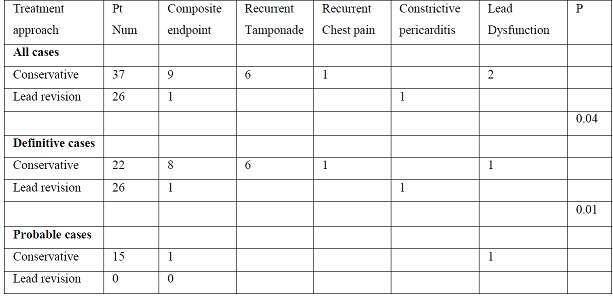
The study included 63 perforation cases, of which 48 definitive and 15 probable cases. Thirty seven cases were managed conservatively and 26 cases via lead revision. Lead revisions were all performed upon a definitive diagnosis, while probable cases were all managed conservatively. Conservative management was associated with increased composite endpoint compared with lead revision when analyzing all cases (9/37 versus 1/26; p-0.04); and more so when analyzing definitive cases only (8/22 versus 1/26; p-0.01) (Table 1). The dominant complication among the conservative group was recurrent PEf with a tamponade effect, 5/6 of which occurred in cases treated by anti-platelets or anti-coagulants shortly after CIED implantation. Probable perforations were managed conservatively with a low complication rate (1/15).
Conclusion:
Conservative management of CIED lead perforation is associated with increased complications compared with lead revision, and should be restricted to cases with normal lead function in which anti-platelets and anti-coagulants could be withheld and close F/U maintained to detect recurrence of PEf.


Powered by Eventact EMS