
“Hybrid” Approach for IC Flutter- Is It Worthwhile?
Background:
A common approach to patients who developed atrial flutter (AFL) secondary to treatment with class 1c anti-arrhythmic drugs (AAD) for atrial fibrillation (AF), is a hybrid approach: ablation of the Cavo-Tricuspid isthmus (CTI) and continuing 1C medical treatment to prevent AF.
Objectives:
To examine the effectiveness of the hybrid therapy approach in preventing recurrence of AF, in patients with AFL secondary to 1C and history of AF.
Methods:
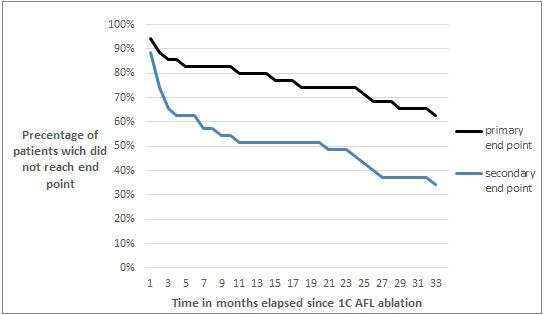
Data of 393 Patients who underwent CTI ablation for typical AFL at our institute between 2010 and 2016 were retrospectively analyzed. Thirty-Five (9%) were on 1C drugs for AF and underwent CTI ablation for 1C flutter. Our primary endpoint was failure of the 1C drug resulting in either upgrade to another AAD or pulmonary vein isolation (PVI). The secondary end point was any documented AF on 1C drug but without need to escalate therapy for AF.
Results:
During an avg. follow up of 33.3± 22 months, 23 (65.7%) patients developed AF or Lt. sided AFL during an average time of 8.44±10.57 months. Fifteen patients (42.7%) reached the primary end point. In 7/15 (47%) there was a need to escalate AAD therapy for AF and in 8/ 15 (53%) PVI was performed. The average time since CTI ablation till need for any escalation therapy for AF was 12.15±11.8 months. Figure 1 shows percentage of patients with freedom from the primary endpoint and secondary endpoint.
Conclusions:
There is a relatively high rate failure of hybrid therapy approach for AF prevention as a substantial number of patients develop AF in short term follow up and many will need escalation therapy.
Figure 1:
KM curve showing freedom from both endpoint:

Powered by Eventact EMS