
Desalinated Seawater Supply and All-Cause Mortality in Hospitalized Acute Myocardial Infarction Patients from the Acute Coronary Syndrome Israeli Survey 2002-2013
2Department of Management, Bar Ilan University
3Sackler Faculty of Medicine, Tel Aviv University
Background:
Consuming desalinated seawater (DSW) as drinking water (DW) may reduce magnesium in water intake causing hypomagnesemia and adverse cardiovascular effects.
Methods:
We evaluated 30-day and 1-year all-cause mortality of acute myocardial infarction (AMI) patients enrolled in the biannual Acute Coronary Syndrome Israeli Survey (ACSIS) during 2002-2013. Patients (n=4,678) were divided into 2 groups: those living in regions supplied by DSW (n=1,600, 34.2%) and non-DSW (n=3,078, 65.8%). Data were compared between an early period [2002-2006 surveys (n=2,531) - before desalination] and a late period [2008-2013 surveys (n=2,147) - during desalination].
Results:
Thirty-day all–cause-mortality was significantly higher in the late period (Fig.1B) in patients from the DSW regions compared with those from the non-DSW regions (HR=2.35 CI 95% 1.33-4.15, p<0.001) while in the early period there was no significant difference (HR=1.37 CI 95% 0.9-2, p=0.14) (Fig. 1A). Likewise, there was a significantly higher 1-year all-cause mortality in the late period in patients from DSW regions compared with those from the non-DSW regions (HR=1.87 CI 95% 1.32- 2.63, p<0.0001), while in the early period there was no significant difference (HR=1.17 CI 95% 0.9-1.5, p=0.22). Admission serum magnesium levels (M±SD) in the DSW regions (n=130) was 1.94±0.24 mg/dL compared with 2.08±0.27 mg/dL in 81 patients in the non-DSW (p<0.0001).
Conclusions:
Higher 30-day and 1-year all-cause mortality in AMI patients, found in the DSW regions may be attributed to reduced magnesium intake secondary to DSW consumption.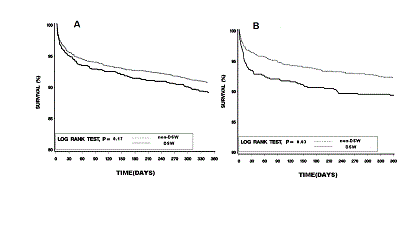

Powered by Eventact EMS