CONTROLLING AND UTILIZING THE PRO-OXIDANT & ANTIOXIDANT ACTIVITIES OF BIOCONJUGATED METALLOCORROLES
Chemistry, Technion - Israel Institute of Technology, Haifa
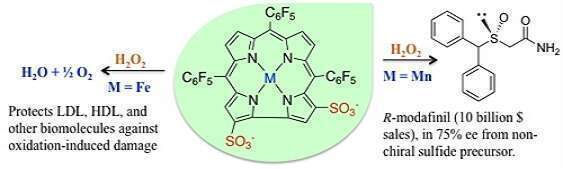
Heme containing enzymes are responsible for both the destruction and the utilization of reactive oxygen species (ROS). While catalases and peroxidases have the same prosthetic group (iron(III) protopophyrin IX), the former disproportionate H2O2 for protecting vital biomolecules against damage by it and the latter utilize H2O2 as oxidant for biosynthesis. Utilization of synthetic metal complexes for similar purposes requires control on their capability to both catalyze and prevent the oxidation of organic molecules by ROS.
Corrole and porphyrin metal complexes share many properties, but the trivalent states are more reactive and the high valent oxo-meal species are much more stable in the former case. Several years ago we have started using these characteristics for selective oxidation of organic molecules, small molecule activation, and decomposition of ROS in biological environments. Examples that will be presented include the enantioselective synthesis of an approved drug via biocatalysis [1], the utilization of amphipolar metallocorroles as catalytic antioxidants in preclinical studies of diseases that are affected by reactive oxygen and nitrogen species [2-4], and selective four-electron reduction of oxygen to water [5].
REFERENCES
1. I. Nigal-Etinger, A. Mahammed, Z. Gross Cat. Sci. Tech. 2011, 1, 578.
2. Z. Okun, L. Kuperschmidt, M. B. H. Youdim, Z. Gross Anti Cancer Agents in Medicinal Chemistry 2011, 11, 380.
3. A. Haber, M. Aviram, Z. Gross Chemical Science 2011, 2, 295.
4. A. Mahammed, Z. Gross Cat. Sci. Tech. 2011
, 1, 535.
5. A. Schechter, M. Stanevsky, A. Mahammed, Z. Gross Inorg. Chem. 2012, 51, 22.
Powered by Eventact EMS