NOVEL TRANSITION METAL MOLYBDENUM COMPLEXES AND THEIR APPLICATION IN OXYGENATION CATALYSIS
Heterobimetallic catalyst systems are key to many of todays major industrial processes. Among these the Perstorp-Formox-Process is especially noteworthy as it is used to generate most of the worlds yearly 20 mil. ton production of formaldehyde[1]. Here at ambient pressure and 270-400 °C, methanol is partially oxidized at a mixed-phase iron-molybdate catalyst employing air as the oxidant[2].
Against this background, our goal is to create novel soluble complexes based on iron and molybdenum as structural models for isolated species on the catalysts surface. Moreover we intend to examine the catalytic performance of these compounds in the oxygenation of model substrates.[3,4]
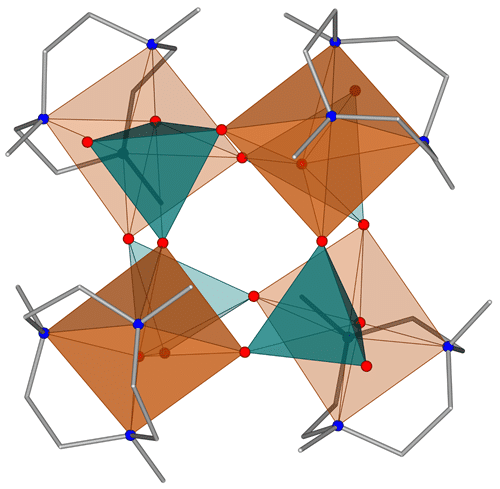
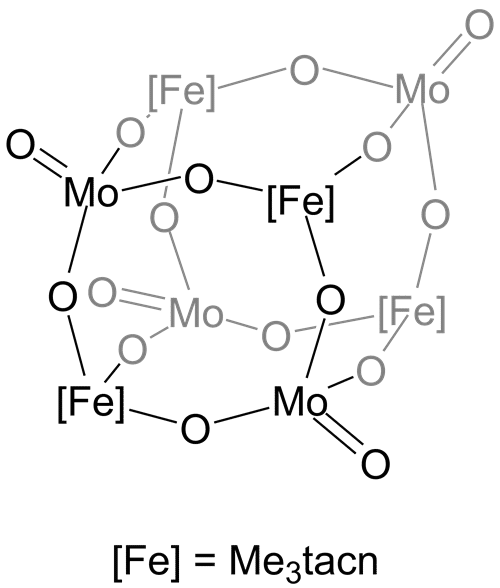
Here we report the syntheses of a series of heterobimetallic transition metal complexes of variable stoichiometry bearing oxide ligands bridging the metal atoms.
Preliminary results of experiments regarding their reactivity towards oxidizing reagents and electrochemical behaviour in solution are presented.
[2] A.P.V. Soares, M.F. Portela, A. Kiennemann, Catal. Rev. 2005, 47, 125–174.
[3] K. Schröder , S. Enthaler, B. Bitterlich, T. Schulz, A. Spannenberg, M.K. Tse, K. Junge, M. Beller, Chem.
Eur. J. 2009, 15, 5471–5481.
[4] K. Schröder, X. Tong, B. Bitterlich, M.K. Tse, F.G. Gelacha, A. Brückner, M. Beller, Tetrahedron Lett.
Powered by Eventact EMS