Clinical and Echocardiographic Outcomes after Aortic Valve Repair in Patients with Bicuspid or Unicuspid Aortic Valve
2Cardiology, Sheba Medical Center, Tel Hashomer
Objectives:
Bicuspid aortic valve (BAV) is a common congenital cardiac anomaly that is associated with valvular complications and aortopathies. Aortic valve repair (AVr) is an alternative for aortic valve replacement (AVR) in carefully selected patients with aortic insufficiency (AI). AVr in patients with BAV, who are young in general when going for operation, have the advantage of avoiding the complications associated with prosthetic valves and the use of anticoagulations.
Methods:
From 2004, 81 patients with BAV or unicuspid aortic valve (UAV) underwent AVr in our institution. The surgical technique in 43 patients (53%) includes replacement of the aortic root with or without cusp repair, in 15 patients (19%) the ascending aorta was replaced at the height of the STJ with or without cusp repair, and 23 patients (28%) underwent isolated cusp repair. Preoperative, operative, and postoperative data were prospectively collected from our department database.
Results:
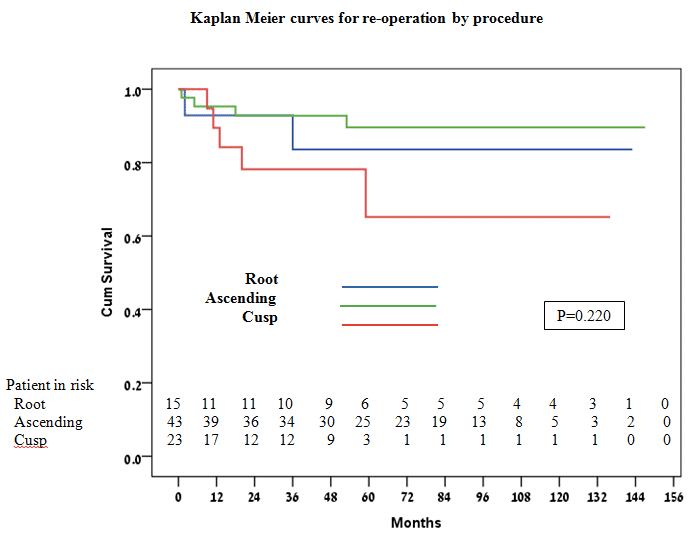
Mean patient age was 42±14 years and the majority were male (94%). The anatomical structure of the aortic valve was bicuspid in 68 patients (84%) and unicuspid in 13 patients (16%). There were no in hospital or in 30 days mortality. One patient experienced a major postoperative complication with CVA. At our follow-up, the 5-years survival rate was 100%. Seventy four patients (91%) had NYHA functional class I-II score during follow-up. Eleven patients required reoperation and the freedom from reoperation at 5 years was 86.4%. The need for reoperation was more in those who underwent isolated cusp repair (p=0.22) and particularly when cusp augmentation with pericardial patch was required for the repair. All of these patients had good early and late results after the reoperation with no complications.
Conclusions:
AVr in patients with BAV or UAV are safe procedures, with good early and late clinical outcomes and very low morbidity and mortality rates.

Powered by Eventact EMS