Variability in the Indexed Left Atrial Volume After Exercise Among Asymptomatic Patients with Severe Degenerative Mitral Regurgitation
2Cardiology, Rabin Medical Center, Hasharon Hospital
3Sackler Faculty of Medicine, Tel Aviv University
Background:
The decision for surgery in asymptomatic patients with severe degenerative mitral regurgitation (SDMR) is often supported by objective assessment of their exercise capacity. The indexed left atrial volume (LAVi) is generally increased in these patients albeit variation in size may be present. We examined the association between the change in LAVi during exercise and exercise capacity in these patients.
Methods:
The study included 23 consecutive asymptomatic patients (65% males, age 61±13 years, range 29-77) with SDMR who underwent stress echocardiography at Rabin Medical Center between 2015-2016. All studies were performed using the Bruce protocol. The LAVi was calculated with the bi-plane Simpson method of the atrium (four- and two-chamber views) indexed to body surface area pre- and immediately post-exercise. Two groups were formed based on the post exercise change in LAVI (ΔLAVI): negative (group A, n=13) and positive (group B, n=10) post-exercise ΔLAVI. Exercise was ended upon achieving target heart rate (220-age) or limiting symptoms.
Results:
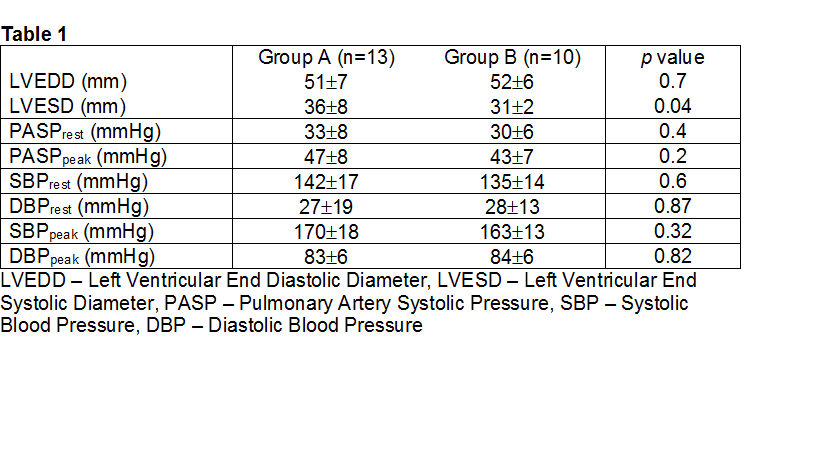
LAVi of the entire cohort was 55±22 at rest and 55±20 ml\m2 at peak exercise. ΔLAVi was -8.8±7.1 ml\m2 in group A vs 11.2±18.4 ml\m2 in group B. The patients in group A had larger LAVi at rest (62±25 vs 45±10 ml\m2, p=0.04), however the peak exercise LAVi was similar (53±20 vs 46±22 ml\m2, respectively, p=0.7). Both groups had similar MR grade (by ERO and regurgitation volume), pulmonary pressure and blood pressure at rest and peak exercise (Table 1). The left ventricular end systolic diameter was greater in group A (p=0.04). Both groups had similar exercise duration (9±3 vs 11±3 minutes, p=0.2).
Conclusion:
Asymptomatic DSMR patients with reasonable exercise capacity and without pulmonary hypertension, show diverse response in LAVi during exercise despite similar exercise capacity and hemodynamics. This may suggest variation in atrial adaptation in response to changes in left ventricular function (LVESD).

Powered by Eventact EMS