
Health Utilization Patterns Prior to Out of Hospital Cardiac Arrest
2Medicine, University of Toronto
3Institute for Clinical Evaluative Sciences, Institute for Clinical Evaluative Sciences
4Department of Mechanical & Industrial Engineering, University of Toronto
5Rescu, Li Ka Shing Knowledge Institute, St. Michael's Hospital
Introduction:
Although Out of hospital cardiac arrest (OHCA) is often considered an unexpected event, some studies have recently shown that patients may have symptoms or encounters to health care system prior to arrest. Our main objective was to evaluate patterns in health utilization care in OHCA patients prior to arrest in a large unselected population.
Methods:
We conducted a population-based cohort study linking the Toronto RescuNET cardiac arrest database with administrative databases in Ontario, Canada. We included patients with non-traumatic OHCA from December 1, 2005 to December 31, 2014 and collected data on physician’s visits, emergency departments (ED) visits and hospitalizations that occurred up to 3 years prior to the arrest. Models were built in order to compare the predicted and the actual rates of health care encounters.
Results:
The cohort included 47,921 patients, 5,858 (12.2%) of them were presented with shockable rhythm. Health utilization rates were relatively stable until 90 days prior the arrest. Overall, 14,826 (30.9%) patients visited the ED, 9,261 (19.3%) were hospitalized, and more than 80% were seen by a physician within 90 days prior OHCA.
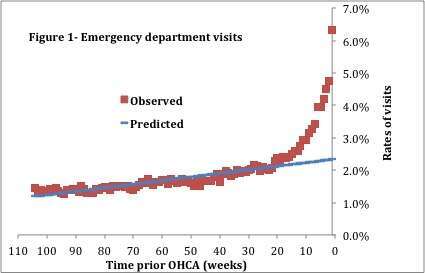
At the month prior to arrest, two thirds of patients were evaluated by a physician. More than 25% of patients met their family physician at the week prior the arrest, in addition ED visits were by 7 folds higher (figure 1), and hospitalizations were by 4 folds higher compared with the predicted rates.
Conclusions:
There is a significant increase in health utilization prior OHCA. Further studies are required to better understand the causes for this increase in order to define patients at risk.

Powered by Eventact EMS