Aortic Annulus Compliance Assessment Using Annular Deformation Dynamics in Transcatheter Aortic Valve Implantation Treated Patients
2Faculty of Engineering, School of Mechanical Engineering, Tel-Aviv University
Background:
Suitable radial pressure of the transcatheter-heart-valve (THV) within the aortic-annulus is critical for sufficient, yet a-traumatic grasping/sealing of the neo-valve apparatus. This is being accomplished by THV oversizing algorithms, which are based on anatomical elements. Nevertheless, fitting the THV for the individual anatomical measures while ignoring his potential physiological singularities may be suboptimal, as this radial pressure depends on the relationship between THV oversizing and the degree of aortic annular compliance (AAC). We thought to offer a novel modus-operandi to measure AAC and to study its’ physical characteristics using deformation dynamics.
Methods:
AAC was determined by measuring the absolute change in aortic-annular-area (with ECG-gated-cardiac-CTA) with relation to the corresponding (equivalent % RR-interval) left ventricular and aortic root pressures, measured systematically in the catheterization laboratory. We then evaluated AAC characteristics, associating factors and relation with predefined TAVI outcomes.
Results:
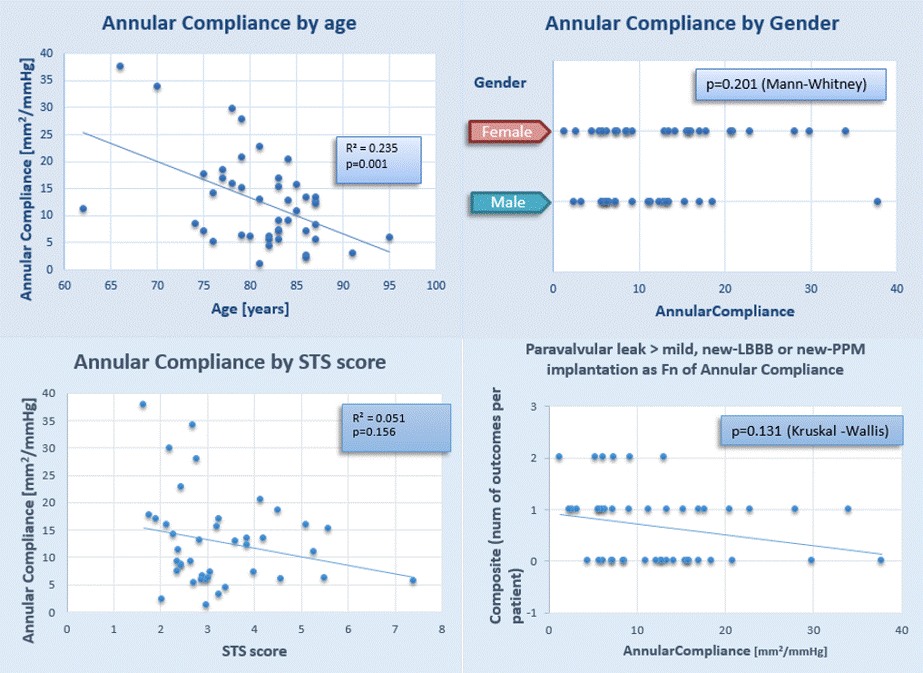
Forty eight patients with severe aortic stenosis (age: 81 ± 6.4 years, 44% males, STS-PROM: 3.4 ± 1.3 %) were included in the analysis. During the cardiac cycle, the mean increase in LV pressure was 143 ± 42 mmHg, and the concordant increase in aortic-annular area was 50.8 ± 29 mm2 (13 ± 7.5 %): from 385 ± 81 mm2 (diastole) to 436 ± 92 mm2 (systole). Accordingly, AAC [mm2/mmHg] was calculated to be 12.6 (SD, 8.3) mean; 11.3 [IQR, 6.2-15.9] median; 1.2 to 37.7 range. AAC was associated with age (p=0.001) but independent from other patients’ characteristics including gender. ACC was not significantly associated with post procedural para-valvular leak and/or new electrical conduction abnormality post TAVI.
Conclusions:
AAC was found to be associated with ̴ 7 mmHg pressure increment for each 1-percent THV oversizing, to widely vary between patients, and to decrease with age. AAC measurement method reproducibility, its potential association with outcomes and future clinical utilization needs further investigation.

Powered by Eventact EMS