
Normal Reference Values for Chamber Size and Function in Elite Athletes: A Meta-Analysis of Cardiac Magnetic Resonance Studies
2Divisions of Cardiology and Clinical Epidemiology, Jewish General Hospital, McGill University
3Cardiology, McGill University Health Centre
4Cardiology, Sha'are Zedek Medical Center, Ben Gurion University
5Division of Clinical Epidemilogy, McGill University Health Center
Background and Aim:
Intense exercise in elite athletes is associated with structural and functional remodeling, such that traditional reference values for chamber size and function are not applicable. The lack of athlete-specific reference values has led to clinical uncertainty in differentiating physiological remodeling from pathological processes. Importantly, data from cardiac magnetic resonance (CMR) studies in athletes remains inconclusive due to limited sample size. We conducted a meta-analysis of published literature to establish gender-based normal reference values for ventricular volumes and ejection fraction by CMR.
Methods:
We systematically searched the Cochrane Library, EMBASE, and MEDLINE databases (from inception to May 2016) to identify all published CMR studies of elite athletes participating in endurance and strength sports. We limited the current analysis to CMR protocols that incorporated SSFP sequences at 1.5T or 3T. Three point estimates were generated by a hierarchical Bayesian random-effect model: a median value, upper reference value (URV), and lower reference value (LRV) for each parameter of the following – absolute and indexed biventricular end-systolic and end-diastolic volumes, as well as biventricular ejection fraction.
Results:
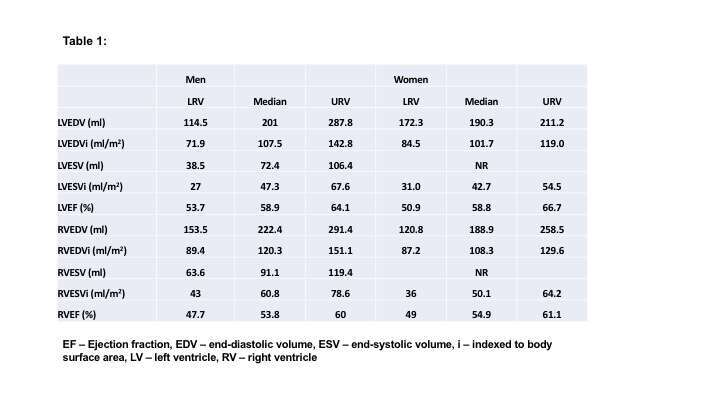
26 studies encompassing 277 female and 943 male athletes, (mean age range 22-68 years), met our inclusion criteria. Most Studies included either athletes participating in high-dynamic, high-static sports (triathlon, rowing, canoeing/kayaking, cycling), high-dynamic, low-static sports (marathon, soccer, tennis) or high-dynamic, medium-static (swimming, handball) or various combinations of the above. Only a single study included athletes participating in high-static, low-dynamic sport (weightlifting). In the pooled meta-analysis, the median values, LRVs and URVs of the gender-based biventricular volumes and ejection fractions are presented in Table 1.
Conclusions:
The results of this meta-analysis provide novel reference values for cardiac chamber size and function measurements by CMR in male and female endurance and strength athletes.

Powered by Eventact EMS