Usefulness of the CHA2DS2-VASC Score to Predict Death or Stroke Risk Regardless of Atrial Fibrillation in Patients Undergoing Transcatheter Aortic Valve Implantation
Background:
Risk assessment for trans-catheter aortic valve implantation (TAVI) patients remains challenging especially among elderly and high risk candidates. Although several risk factors have been found to contribute to increased morbidity and mortality following TAVI, simple risk scores for daily practice use are lacking. The application of the CHA2DS2-VASC score as a novel risk stratification tool for predicting outcome in clinical applications other than atrial fibrillation (AF) and stroke prevention has been previously examined. However its usefulness in a population of patients with aortic stenosis following TAVI has not been established.
Methods and Results:
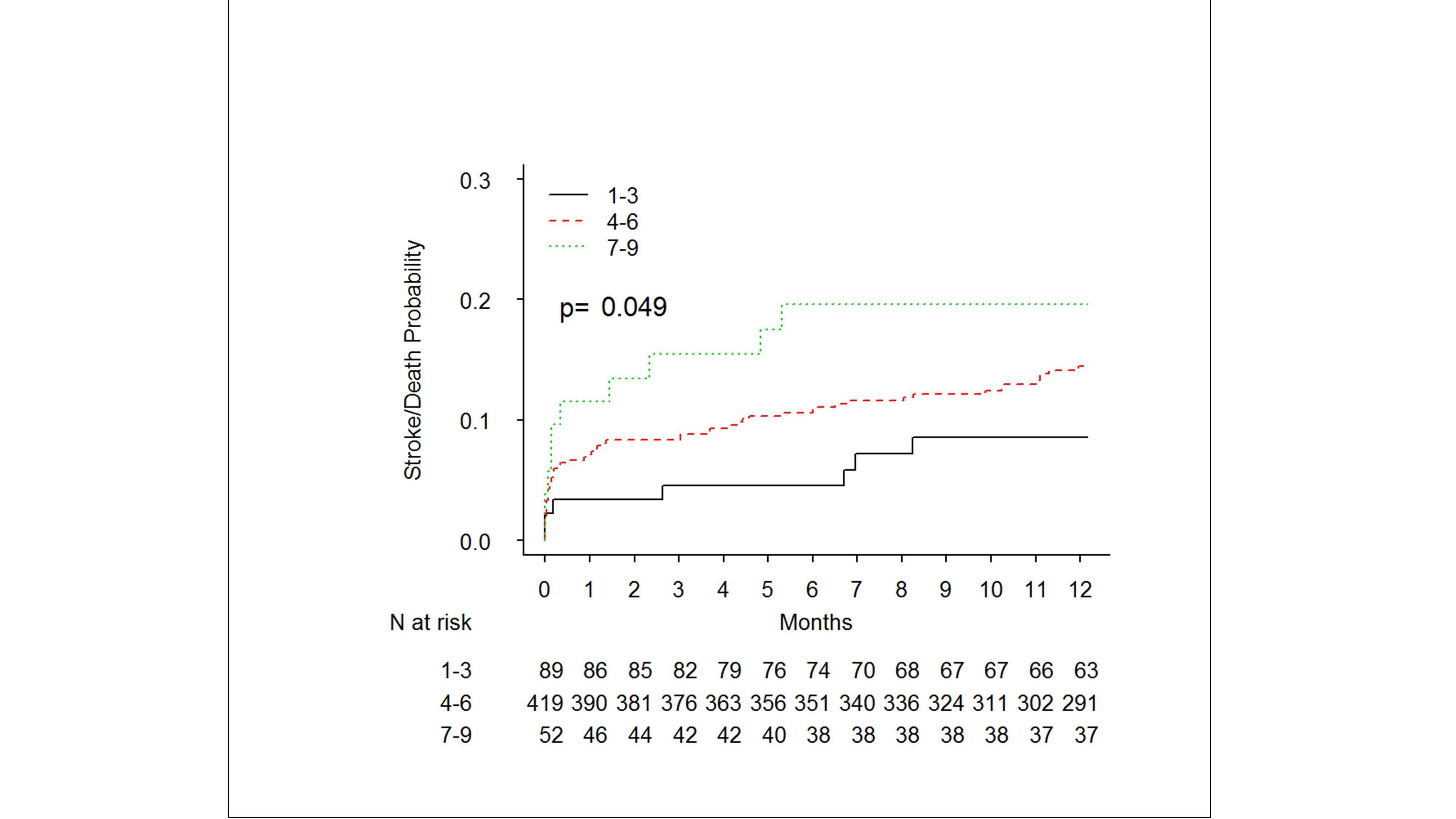
We investigated 560 consecutive patients who underwent TAVI between in our institution and computed the CHA2DS2-VASC score on the day of their procedure. We assessed the relation between the CHA2DS2-VASC score and clinical outcomes (e.g. all-cause mortality and combined outcome of mortality or stroke) at 1 year following TAVI.
Most patients (83.7%) had a CHA2DS2VASC score > 3 with the most frequent score of 4 obtained in 183 (32.7%) of patients. Both outcomes at 1 year were significantly more frequent at CHA2DS2-VASC score of 4 and beyond. The CHA2DS2-VASC score was found to be significant predictor for the combined outcome of death and stroke (p=0.049). Figure
Conclusion:
The CHA2DS2-VASC score can be used as a simple and effective tool to predict long term clinical outcomes including death and stroke in patients undergoing TAVI irrespective of atrial fibrillation.

Powered by Eventact EMS