The Impact of Aspirin Withdrawal in Acute Coronary Syndrome Patients Treated with Novel P2Y12 Inhibitors - A Platelet Reactivity Study
2Institute of Thrombosis & Hemostasis, Sheba Medical Center
Introduction:
Dual antiplatelet therapy has become the gold standard therapy in ACS patients and post PCI. Yet it has been shown that the use of aspirin increases the risk of GI bleeding in a dose related manner.Recently it was demonstrated in an analysis from the PLATO study that aspirin, when given at a high dose concomitantly with the novel P2Y12 blocker ticagrelor, is associated with a higher incidence of thrombotic events. Thus, it was suggested that aspirin in patients treated with novel P2Y12 inhibitors might cause more harm than benefit. We sought to evaluate the impact of withholding aspirin on platelet reactivity in ACS patients receiving novel P2Y12 inhibitors.
Method:
A prospective, randomized controlled, double-blind crossover trial, conducted among NSTEMI patients who underwent PCI.Patients were prospectively randomized one month after the index event to treatment with either placebo or aspirin for two-weeks. Thereafter patients were crossed-over to the other therapeutic arm (patients treated with aspirin were switched to placebo and vise-versa). Platelet reactivity to AA and ADP using light-transmitted aggregomotry as well as VerifyNow assay were conducted at baseline, 2, and 4 weeks after randomization.
Results:
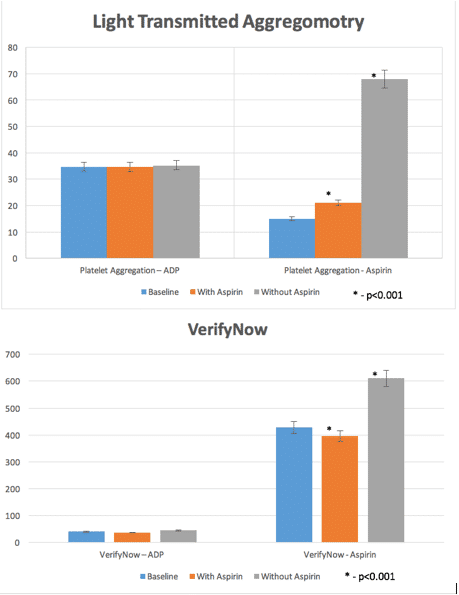
Twenty patients comprised the study cohort. Evaluating platelet reactivity response to ADP both by conventional aggregometry and VerifyNow tests didn’t show any difference (35±3.1vs.35±3.4,p=0.67;36±6.36vs.45±9.7,p=0.66, respectively) for aspirin vs placebo. Evaluation of the AA pathway demonstrated that aspirin withdrawal resulted in a significant higher induced AA induced platelet reactivity (21±4.86vs.68±5.4,p<0.001;396±13vs.611±11, p<0.001, respectively) (figure). During the trial no adverse clinical events were observed.
Conclusion:
Aspirin withdrawal is associated with increased AA induced platelet reactivity in patients receiving novel P2Y12 inhibitors. To the best of our knowledge the current trial is the first to study the significance of withholding aspirin in post ACS patients and it is further warranted to determine the clinical significance of our findings.

Powered by Eventact EMS