Establishment of a Retrospective Study Cohort of Non-Valvular Atrial Fibrillation (NVAF) Patients in Maccabi Healthcare Services, 2007-2015: A Database Study
2Sackler Faculty of Medicine, Tel-Aviv University
Background:
Computerized databases of healthcare services providers are being increasingly utilized to assess epidemiology of diseases, treatment patterns and healthcare resource utilization. Based on the comprehensive database of Maccabi Healthcare Services (MHS) we established a cohort of NVAF patients for the years 2007-2015.
Objective and Methods:
We aim to describe the MHS NVAF cohorts’ inclusion and exclusion criteria, and trends in incidence and prevalence of NVAF between the years 2007 and 2015 in comparison with existing databases. A total of 49,988 adults, MHS members at or after 2007, were diagnosed with atrial fibrillation (AF). Cases were counted if they were given at least one AF diagnosis by a primary care physician, cardiologist, at hospital, or had an operative ablation of supraventricular arrhythmogenic focus or pathway (CPT code 33250).
Results:
Of eligible 26,317 incident AF cases, 5,777 (22.0%) had valvular disease prior to diagnosis. Women comprised 46.8% of the remaining 20,540 NVAF cohort, and were older than men (mean(SD): 71.1 (14.4) vs. 67.3 (14.3) years, respectively). The average annual incidence for the years 2007-2015 was lower than that reported by another Israeli healthcare services provider, but comparable to recent reports from Quebec and from the UK (fig. 1). The full inclusion and exclusion criteria, patient characteristics, and incidence and prevalence time trends will be presented.
Conclusion:
In an era of an increasing number of studies based on computerized databases, it is important to compare cohort characteristics and age- and sex-specific incidence rates with data from other cohorts. The current cohort will allow to study important clinical and economic implications in light of the aging population in Israel and the costly medication for NVAF included in the national health basket.
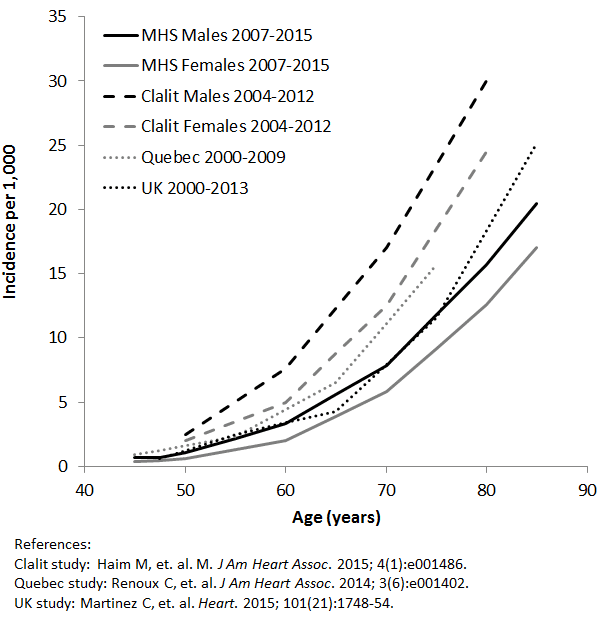
Figure 1. Average annual incidence of NVAF by age and sex in MHS 2007-2015 (N=20,540) and comparison with recent published studies

Powered by Eventact EMS