Thiamine Status Predicts Outcomes in Cardiac Surgery
2Clinical Biochemistry Lab, Rambam Health Care Campus
Background:
Thiamine is essential for mammalian aerobic metabolism and thiamine deficiency disorders, including Beriberi and Wernicke-Korsakoff syndrome, are well known. Recently, there is renewed interest in perioperative thiamine status in patients undergoing cardiac surgery. However, the impact of subclinical thiamine deficiency on postoperative complications in these patients has yet to be fully elucidated. The aim of this study was to investigate the predictive value of thiamine status with respect to adverse outcomes, and to identify a prognostically significant thiamine cut-off value in cardiac surgical patients.
Methods and Results:
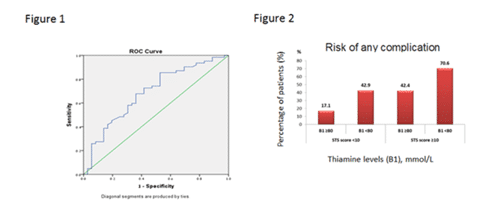
Demographic data, whole blood thiamine levels, and surgical outcomes were collected prospectively from 98 patients undergoing cardiac surgery in our institute. A receiver-operating characteristic (ROC) curve was plotted to obtain the best cut-off value for baseline thiamine level to predict a composite endpoint of neurological, cardiovascular, respiratory and renal morbidity, in addition to surgical wound infection and mortality. The analysis yielded a cut-off value of 80 mmol/L (ROC = 0.69; 95% confidence interval (CI) 0.58-0.8, Figure 1). The incidence of a composite complication was 62.5% (15/24) in patients with preoperative thiamine level ˂80 mmol/L as compared to 28.4% (21/74) in patients with thiamine levels above this value (95% CI 0.09-0.63, P=0.004). Following adjustment for Society of Thoracic Surgeons` (STS) risk score of 10%, thiamine level ˂80 mmol/L was an independent predictor of postoperative complication (adjusted odds ratio (OR) = 3.39; 95% CI 1.2-9.3, P value <0.018, Figure 2). Moreover, the prognostic value of STS risk model increased significantly when combined with thiamine status ˂80 mmol/L (without thiamine: ROC = 0.67; 95% CI 0.56-0.8, with thiamine: ROC = 0.72; 95% CI 0.61-0.83).
Conclusions:
This study demonstrated an association between thiamine status and cardiac surgical outcome independent of previously recognized risk factors, as well as identifying a thiamine cut-off value predictive of adverse outcomes.

Powered by Eventact EMS