Prediction of Mortality in Hospital Survivors of STEMI: External Validation of a Novel Acute Myocardial Infarction Prognostic Score
2Cardiology Department, Rabin Medical Center
3Faculty of Health Sciences, Ben-Gurion University of the Negev
Introduction: Recently we developed and internally-validated a new risk-score, the "Soroka" Acute Myocardial Infarction (SAMI) Score. It is a simple score based entirely on “real-life” easily available clinical information, including a variety of cardiovascular parameters and co-morbidities and has been shown be highly accurate in prediction of all-cause long-term mortality (c-statistic 0.83-0.94) in hospital survivors of AMI.
Objectives: We aimed to perform an external validation of the SAMI score for prediction of all-cause mortality in STEMI patients undergoing PCI and define the long-term prognostic mortality outcome in another large medical center.
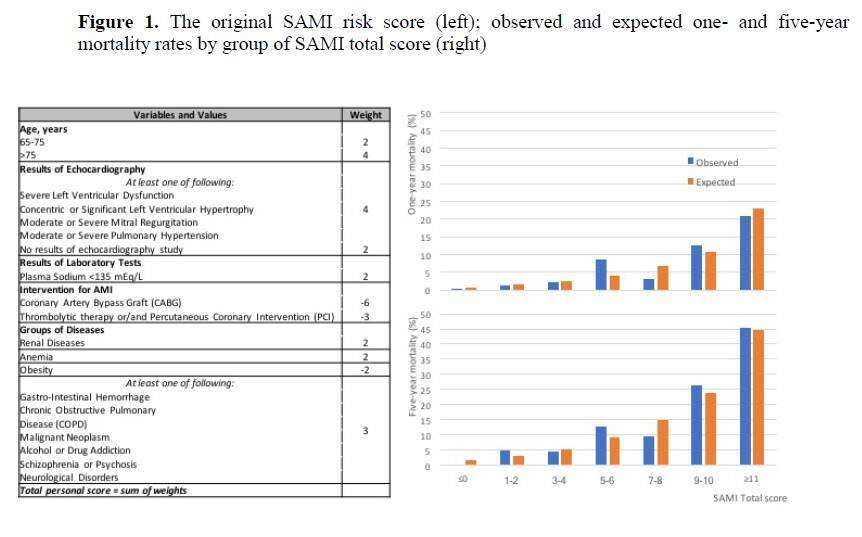
Methods & Settings: A prospective database of 1287 consecutive STEMI patients treated by primary PCI and discharged alive from the validation hospital between 2004 and 2014 (age 60.8±12.5 years, 83% males) was used. Outcomes measures included as follow: one- and 5-year post-discharge all-cause mortality (3.8% and 8.1% respectively). The definition of the variables and their scoring were in consistency with the original SAMI score (Figure-1a). The accuracy of the SAMI score was assessed using Chi-square test and logistic regression for calibration, and c-statistic (ROC procedure) for discrimination.
Results: The SAMI total-score values ranged between (-5) to (+15) points (median 2 points). Higher personal total score was related to greater risk for dying: a one point increase was associated with OR of 1.33 (95% CI: 1.24-1.42, p<0.001) and 1.37 (95% CI: 1.29-1.44, p<0.001) for one and 5-year mortality respectively. No statistical differences between observed and expected mortality rates by groups of the total SAMI score were found (Figure-1b). The c-statistics were 0.818 and 0.830 for one and 5-year mortality, respectively.
Conclusions: The SAMI risk score is a strong and well validated prognostic tool for up-to 5-years all-cause mortality in hospital survivors of STEMI. Additional multi-center studies with larger diverse cohorts are warranted to further validate and generalize this score.

Powered by Eventact EMS