CT based aortic valve calcium density is a better predictor than Agatston score for immediate perivalvular leak in TAVI patients
2Biostatistics, Lady Davis Carmel Medical Center
Background:
Aortic valve (AV) calcification is a predictor of adverse outcome in patients undergoing Trans Catheter Aortic Valve Implantation (TAVI). However, the Agatston score developed for coronary atherosclerosis is not a linear model and was not designed for TAVI patients. The aim of this study was to estimate AV calcification patterns related to immediate post procedural outcomes.
Methods:
Overall, 87 patients (mean age 80.8±7.5 years, 56 % female) undergoing TAVI who had a pre-procedural non-enhanced 256-slice CT scan were included. CT based AV calcium was evaluated for Agatston score, Volume (in mL) and mass (in mg) using commercially available software (Philips). Immediate post TAVI angiograms were evaluated for ≥grade 2 (0-3 scale) perivalvular aortic regurgitation (PVL). The relation between AV Agatston score and AV calcium density (mass/volume) to immediate perivalvular leak were examined.
Results:
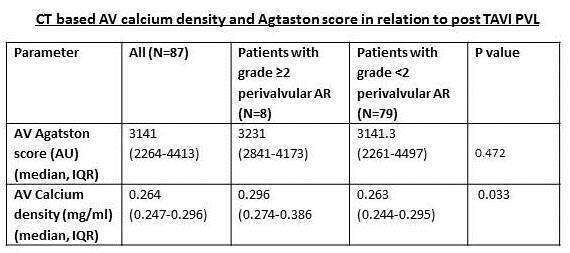
Mean AV Agatston score was 3383 ± 1572 units (range 168-9308). Median CT based AV calcium density was 0.264 mg/ml (IQR 0.247-0.296)). Immediate post procedural ≥2 grade PVL was present in 8/87 (9%) of the patients. AV Calcium density >0.267 had a 9.2 Odds Ratio for immediate grade ≥2 PVL (95% CI (1.09-78.9)) whereas Agatston calcium score was not statistically different between groups (table).
Conclusions:
CT based AV calcium density was higher in TAVI patients with immediate post procedural moderate to severe PVL. A value of >0.267 was associated with a 9 fold increase in the risk of PVL while the Agatston calcium score had lower predictive value.
Our findings suggest that CT based calcium density (calcium mass/volume ratio) may be useful as a predictor of post procedural PVL.
Powered by Eventact EMS