
Does the Type of Prosthesis affect Clinical Outcomes after Valve Replacement in Patients with Rheumatic Heart Disease?
2Cardiology, Sheba Medical Center
Objective:
We investigated the clinical outcomes of rheumatic heart disease patients who underwent valve replacement surgery with either a bio-prosthesis (BP) or mechanical valve prosthesis (MP).
Methods - Of the prospectively followed 3590 patients who underwent valve replacement surgery since 2004, 754 (21%) were found to have rheumatic etiology. Of them, 336 were implanted with a MP and 407 with a BP, 11 patients required both MP and BP and were excluded. These two groups were compared regarding their early and late clinical outcomes.
Results:
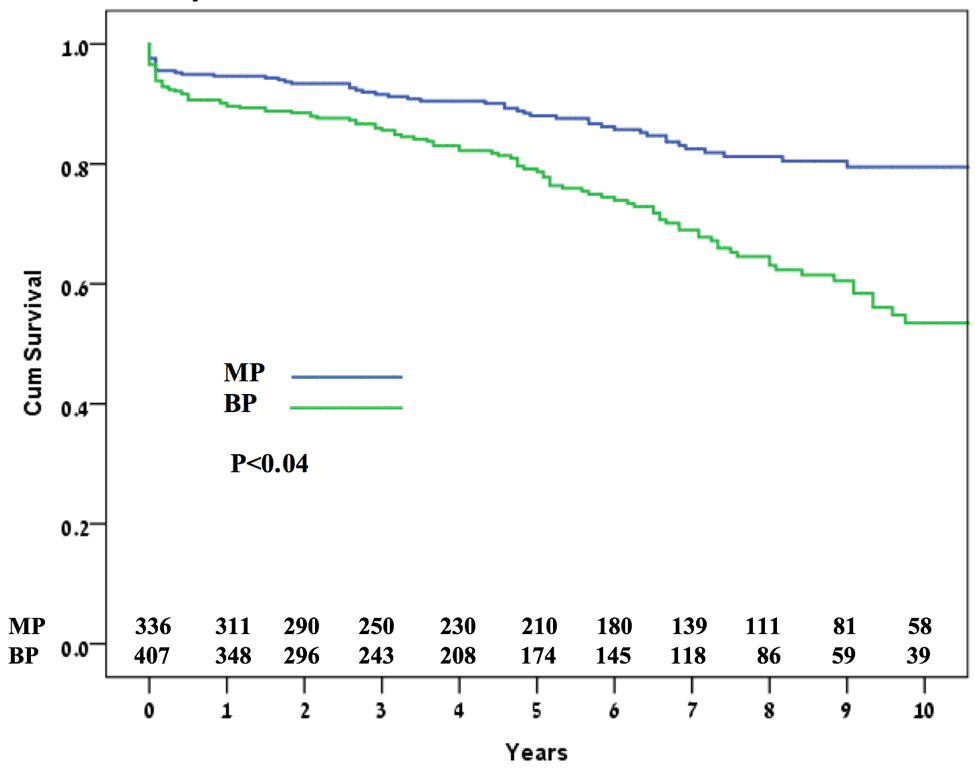
Patients with a BP implant were older with a mean age of 67±11 years compared to 56±9 (p<0.001) and suffered from more co-morbidities. Nevertheless, early mortality did not differ significantly between the groups, with 12 (4%) and 20 (5%) early deaths in the MP and BP groups respectively [HR=1.42(0.51-3.9), p=0.51]. Early complications included need for dialysis in 3 (1%) and 14 (3%) (p<0.03) in the MP and BP groups respectively with no differences in rate of other early complications. Mean clinical follow-up was 42±37 months and up to 14 years. There were 42 (13%) late deaths in the MP group and 89 (23%) in the BP group, with a survival rate of 88% and 79% at 5 years in the MP and BP groups respectively (figure). In a multivariate analysis BP was also found as an independent risk factor for late mortality [HR=1.79 (1.11-1.89), p<0.04]. At follow up, NYHA functional class I or II was 83% in both groups (p=0.89). Freedom from reoperation was 96% and 94% at 5 years in the MP and BP groups respectively (p=0.19). Late echo demonstrated no significant valvular hemodynamics differences between the groups.
Conclusion:
Though early mortality, late functional capacity and late re-operation rate were similar in both groups; Bio-prosthesis valve selection may affect late survival.

Powered by Eventact EMS