
Predictors of Left Ventricular Ejection Fraction during a First STEMI Treated by Early Revascularization: Can We Modify the Left Ventricular Outcome?
2Tel-Aviv Univesity, "Sackler" Faculty of Medicine
 Background:
Door to balloon time is an important quality measure in order to improve STEMI outcomes. Some patients will developed significant left ventricular (LV) dysfunction despite a short time-interval from symptoms onset to coronary revascularization.
Objectives:
We sought to investigate factors affecting LV ejection fraction (LVEF) in STEMI patients who underwent primary PCI within ≤4 hours from symptoms onset (i.e. defined herein as the ischemic time).
Methods and Results:
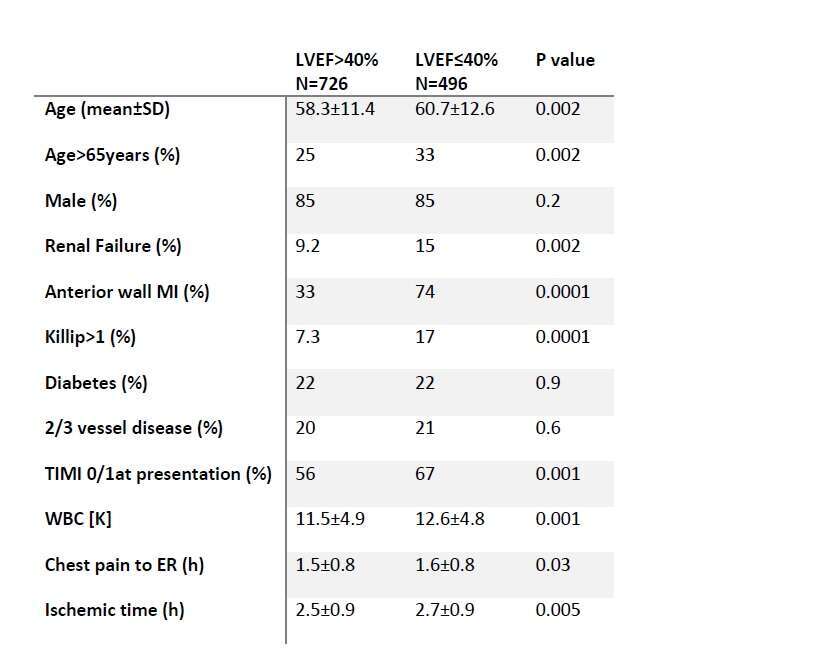
Included were 1,222 consecutive patients with first STEMI who were treated within ≤4 hours of ischemic time. We evaluated two groups of patients as follow: 726 (60%) patients with LVEF>40% and 496 (40%) patients with LVEF≤40%. The characteristics of the 2 groups are detailed in the following Table:
Patients` characteristics stratified by LV dysfunction.
In multivariate analysis, the following variables were associated with LVEF≤40% : age>65 (OR 1.2, p=0.05), renal failure/creat≥1.5 (OR 1.1, p=0.08-trend only), Killip>1 (OR 1.3, p=0.008), total ischemic time 4 - OR 1.5, p=0.001), anterior wall STEMI (OR 1.4, p=0.0001), and pre-TIMI flow 2/3 (OR 0.9, p=0.005).
Conclusion:
During a first STEMI, 40% of patients presented with LVEF≤40%, despite sustaining relatively short ischemic time (≤4 hrs). Some of the predicting factors are modifiable but others are not, calling for an unmet need geared towards improved myocardial salvage and/or functional preservation during the course of STEMI.

Powered by Eventact EMS