
Blood Urea Predicts all-cause Mortality in Patients with Severe Aortic Stenosis
Introduction:
Severe Aortic stenosis (SAS) is the most common valvular heart disease in the western world. Various factors are related to SAS prognosis, including chronic kidney disease. Blood urea nitrogen (BUN) is a less specific marker of kidney function than creatinine. However, according to recent studies, elevated BUN is a better prognostic factor in patients with heart failure.
Hypothesis:
The aim of this study was to evaluate the predictive value of blood urea levels on prognosis in patients with SAS.
Methods:
One hundred and forty two patients (age 79.1±9.4 years, 88 women) with SAS, were enrolled. The mean valve area was 0.67± 0.17 cm2, the mean and peak gradients were 49±16 mmHg and 77±24mmHG, respectively. The mean NYHA class was 2.6±0.7. Clinical assessment, including diuretic treatment, blood tests and echocardiography were performed at enrollment and follow up visits. The primary endpoint was all-cause mortality. The patient population was divided to 2 groups, according to the median urea level at enrolment. The low urea group (72 patients, mean urea 35.5±6.2 mg/dL) and high urea group (70 patients, mean urea 61.1±17.8 mg/dL).
Results:
During a mean follow-up of 37±19.5 months, 56 (37.1%) patients have died, 39 of them due to cardiovascular causes. In univariate analysis, age (HR 1.057; 95%CI: 1.021 - 1.095, P=0.002), categorical urea (HR 2.557; CI 1.509 – 4.332, P=0.0001), creatinine (HR 2.363; CI 1.261 - 4.418, P=0.007) and functional class (HR 1.582; CI 1.096 - 2.284, P=0.014) were associated with all-cause mortality. However in multivariate analysis only age and blood urea were independent predictors of all-cause mortality (HR 1.042; 95% CI 1.004 - 1.081, P=0.029 and HR 1.967; 95% 1.127 – 3.434, p=0.017 respectively, Figure)
Conclusions:
Blood urea, a generally readily available and routinely determined marker of renal function, is an independent prognostic factor in patients with SAS.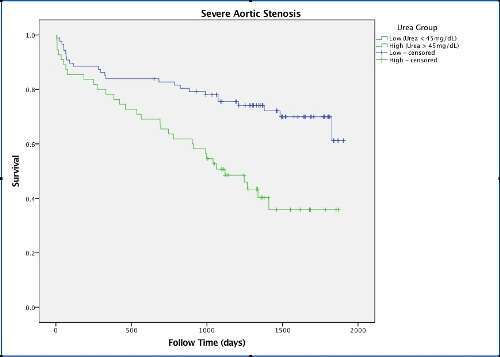

Powered by Eventact EMS