
Biodegradable Polymer Drug Eluting Stents versus Durable Polymer Drug Eluting Stents for Percutaneous Coronary Intervention: A Propensity Score Matched Analysis
2The "Sackler" School of Medicine, Tel Aviv University
Objective:
To date, clinical trial data assessing head-to-head comparisons of modern generation durable polymer (DP) and biodegradable polymers (BD) in drug-eluting stents (DES) have not shown a clear-cut advantage for the BD-DES. However, in most published studies, the duration of follow-up has been limited to one year, which might not be enough time to allow clinically important events to occur. Thus, we aimed to compare the long term outcomes of patients undergoing PCI with BD-DES versus DP-DES.
Methods:
Among 6279 PCIs with second generation DES preformed in our institution between 2007 and 2016, we identified 4547 procedures performed using DP-DES and 1732 using BD-DES. Propensity score matching was used to create a cohort of well-balanced pairs of patients revascularized with BD-DES (Orsiro, Biomatrix, and Nobori) and DP-DES (Xience, Promus, and Resolute). The primary outcome was the composite of all cause death, MI, and re-hospitalization for unstable angina pectoris (UAP) occurring within 5 years of the procedure. Outcomes are presented with Kaplan-Meier curves and compared with Cox adjusted analysis.
Results:
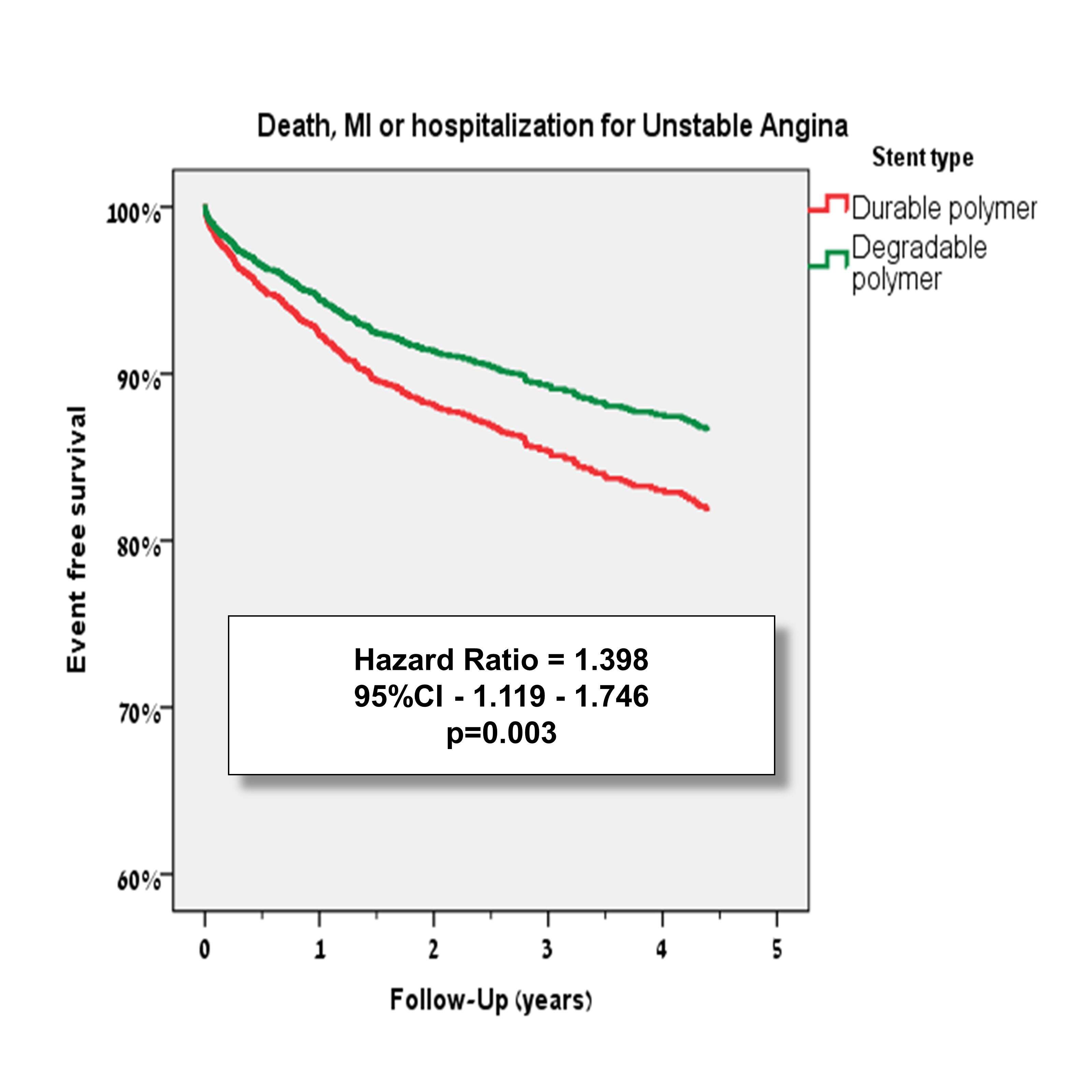
Of 1704 couples matched 21% were females, and the mean age was 65. All variables compared between the BD-DES and DP-DES groups were similar except for mean platelet volume (p<0.001), uric acid (p=0.002), and bifurcation lesion (p=0.007). The composite outcome occurred in 17% and 14% within 5 years (p=0.17). After adjustment for the unbalanced variables in Cox analysis, Hazard ratio for the composite outcome in the DP-DES versus the BD-DES group was 1.4 (95% CI 1.12-1.75; p=0.003) [Figure 1].
Conclusion:
In a propensity score matched cohort of 3464 PCI’s there was a trend for a higher crude event rate in patients with DP-DES vs. BD-DES. After adjustment for unbalanced variables, PCI with DP-DES were associated with a significant 40% increase in the composite outcome of Death, MI and UAP.
Powered by Eventact EMS