
Impact of Left Heart Disease on Survival of Patients With Pulmonary Hypertension
Introduction:
Left heart disease (LHD) is accepted as the most prevalent cause of pulmonary hypertension (PHT). We compared the survival of PHT patients with and without LHD
Methods:
Significant PHT was diagnosed by tricuspid incompetence gradient (TIG) ≥40mmHg on transthoracic echocardiogram (TTE). Survival of patients with and without significant LHD was compared.
Results:
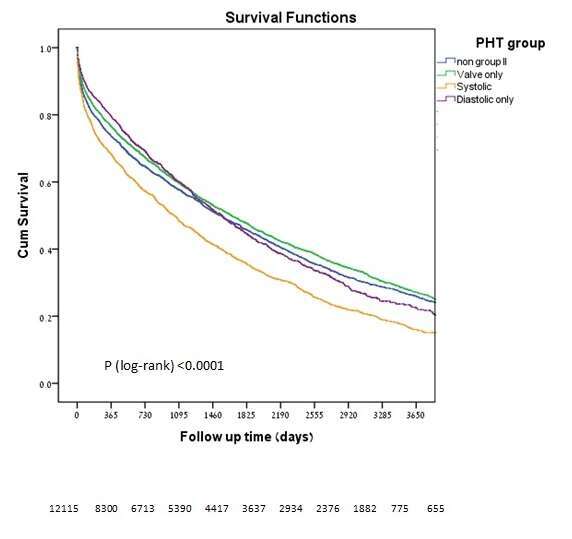
Between 1993 and 2015, significant PHT was diagnosed in 12,115 of 66,949 (18%) patients who underwent echocardiography. Significant LHD was diagnosed in 8306 (69%) patients. The primary diagnoses included valve disease in 51%, LV systolic dysfunction in 28%, and findings consistent with diastolic dysfunction in 21%. Patients with LHD associated PHT as compared to non-LHD PHT were of similar age (75±13 vs 75±14 years p=0.67), less females (50% vs 63% p<0.0001), and had higher TIG (median 48mmHg [IQR 43;55] vs 46mmHg [42;54] p<0.0001). Patients were followed for all cause mortality for a median duration of 29.7 (IQR 5.7;70.2) months. In a multivariate model, independent predictors of mortality were older age (HR 1.05, 95% CI 1.04-1.05 p<0.0001), Higher TIG (HR=1.02, 95%CI 1.01-1.02, p<0.0001), and female gender was protective (HR=0.82, 95%CI 0.79-0.86, p<0.0001). LHD was not a risk factor for mortality among PHT patients (HR=1.04, 95%CI 0.99-1.09, p=0.110). Patients with LV systolic dysfunction had higher mortality as compared to patients with valve disease or diastolic dysfunction (figure) (HR=1.37, 95%CI 1.29-1.47, p
Conclusions:
Survival of patients with pulmonary hypertension and left heart disease is dismal. Patients with LV systolic dysfunction have 37% increased mortality risk as compared to non-LHD PHT. Development of specific therapeutic strategies for this high-risk group is warranted.

Powered by Eventact EMS