The Effect of Sedation on the Assessment of Aortic Stenosis
Background:
Hemodynamic homeostasis is impaired in critical states, particularly in sedated patients. This could alter aortic stenosis (AS) classification which relies on mean pressure gradient (MPG), stroke volume index (SVI) and left-ventricular ejection fraction (LVEF), potentially affecting decision making. We sought to compare TTE assessment performed during sedation with TTE assessment during wakefulness.
Methods:
We prospectively studied 30 patients aged 80 years (76.6-86.5 IQR) with LVEF 60% (46-60 IQR) and moderate or severe AS on prior TTE. Following TTE during wakefulness (TTE1) another TTE (TTE2) was performed during sedation (for concomitant TEE study).
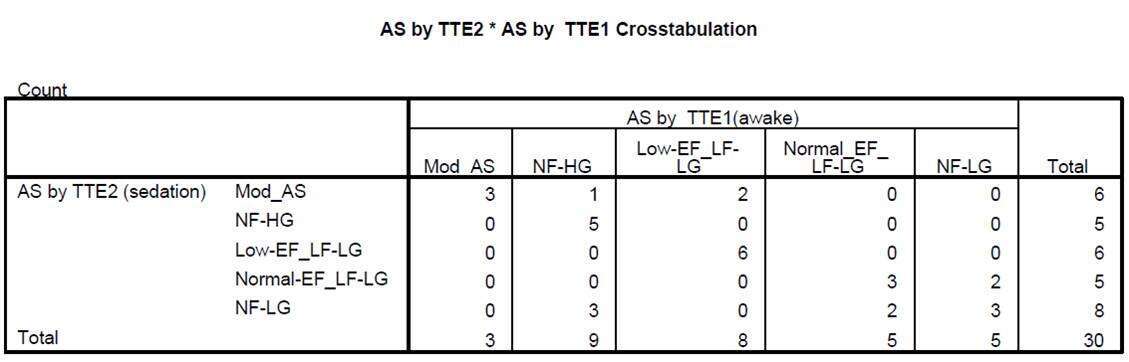
Aortic-valve-area (AVA) was calculated through the continuity equation using the relevant hemodynamic parameters measured by each TTE study. The same left-ventricular-outflow diameter (LVOT) was used for both studies. AS severity and type were classified as NF-HG (Normal-Flow High-Gradient), Low-EF_LF-LG (Low-Flow Low-Gradient), Normal-EF_LF-LG, and NF-LG (Normal-Flow Low-Gradient), using the following cut-off values: LVEF <≥50%, SVI <≥35ml/m2, MPG <≥40 mmHg. AS types were aggregated into Group-A (moderate AS and NFLG) which does not carry a strong surgical/percutaneous indication and Group-B (NF_HG, Low-EF-LFLG, and Normal EF-LFLG) which implies invasive treatment. All parameters were compared during sedation vs wakefulness.
Results:
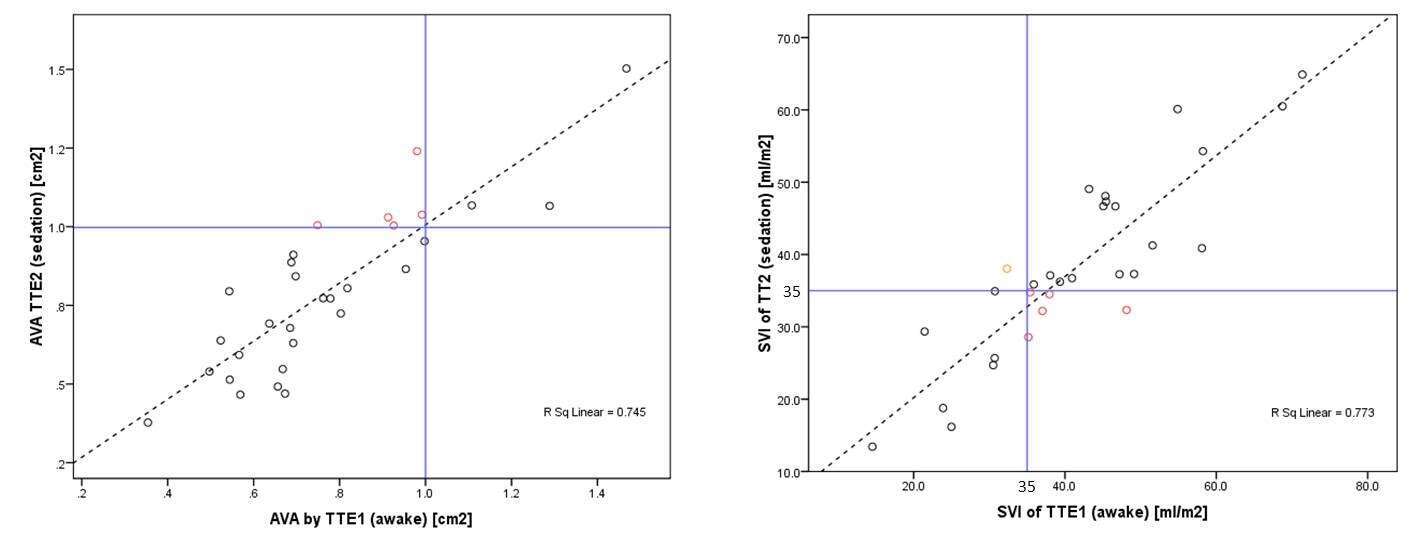
During sedation, systolic blood pressure decreased from 144±22 to 132mmHg±28mmHg (p=0.045), apical MPG from 33.2mmHg±13.2 to 29.3±12.7mmHg (p<0.01), and SVI from 41.4±13.1 to 38.1±12.5ml/m2(p=0.008) . Diastolic pressure, heart rate and AVA (aortic-valve-area) did not change significantly. As shown in attached Figure, on TTE2, AVA was differentially >1cm2 in 5(16.6%), whereas SVI was differentially <35ml/m2 in 4(13.3%) of the patients. Consequentially, AS typing shifted significantly during sedation vs wakefulness as detailed in attached Table, with 8/22(36.4%) of patients in Group-B “downgrading” to Group-A, and conversely, 2/8(25%) of patients in Group A “upgrading” to Group B.
Conclusions:
Hemodynamic conditions during sedation appear to downgrade AS severity in a significant number of patients.

Powered by Eventact EMS