Impaired Fasting Glucose is the Major Determinant of the 20-year Mortality Risk Associated with Metabolic Syndrome in Non-Diabetic Patients with Stable Coronary Artery Disease
Background:
Explore the association of metabolic syndrome (MetS) vs. its individual component, with 20-year all-cause mortality among patients with stable coronary artery disease (CAD).
Methods:
The cohort comprised 12,403 non-diabetic patients with stable CAD who were enrolled in the Bezafibrate Infarction Prevention (BIP) registry between 1990-1992, followed-up for through 2014. Study cohort was divided into four groups: patients without MetS or IFG, with IFG but without MetS, with MetS but without IFG, and with both MetS and IFG.
Results:
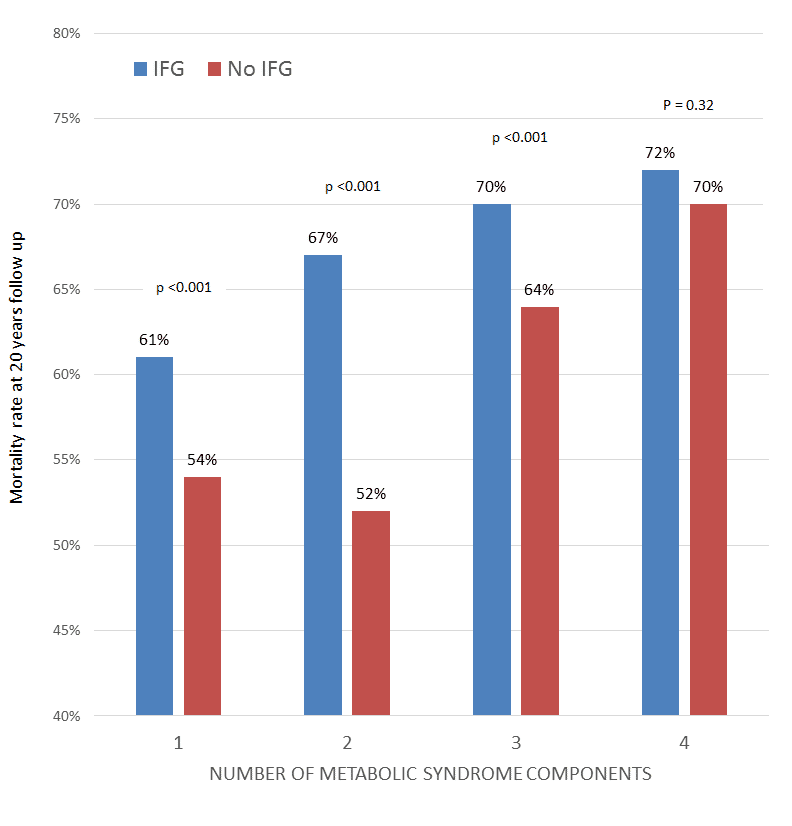
Kaplan-Meier survival analysis showed that at 20 years of follow-up the rates of all-cause mortality were the highest among patients with both MetS and IFG (66%). Patients with IFG without MetS experienced a significantly higher mortality rate compared to those with MetS without IFG (61% vs. 56%, respectively; log rank P <0·001).
Multivariate Cox proportional hazard analysis showed that, the final cox model demonstrated that the additive effect of MetS (HR 1.1x; CI 95% 1.1-1.16; P-value 0.02) and IFG (HR 1.54; CI 95% 1.46-1.62; P-value <0.001) on twenty years mortality was non-significant (HR 1.01; CI 95% 0.93-1.11; P-value 0.69). IFG was associated with the most pronounced increase in mortality risk among the individual components (HR 1·22; 95% CI 1·14 - 1·3; p<0·001).
Conclusion:
Our findings suggest that IFG alone is a major independent predictor of long-term mortality among stable CAD patients than other components of the MetS.

Powered by Eventact EMS