FAVORABLE THERMODYNAMIC OF ANAEROBIC HYDROCARBONS OXIDATION IN HYDROTHERMAL SYSTEMS
Russian Academy of Sciences, Institute of Problem of Chemical Physics, Chernogolovka
The hydrothermal systems of mid-ocean ridges are characterized by the effects of endogenous origin hydrocarbons emission, accompanied by abiogenic products of their oxidation [1].
The С–Н system of aqueous alkanes, alkenes, and alkynes in hydrothermal environment presented as two-phase monovariant equilibria that divided the divariant areas of stability (the facies) of the hydrocarbons (Figure). The existence of those metastable equilibria of hydrocarbons in hydrothermal systems is experimentally proven [2].
The С–Н system of aqueous alkanes, alkenes, and alkynes in hydrothermal environment presented as two-phase monovariant equilibria that divided the divariant areas of stability (the facies) of the hydrocarbons (Figure). The existence of those metastable equilibria of hydrocarbons in hydrothermal systems is experimentally proven [2].
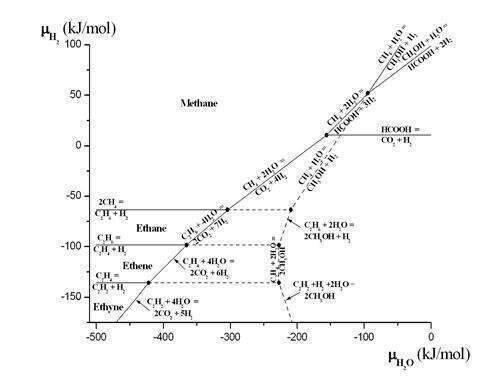
Figure. Anaerobic oxidation of aqueous hydrocarbons on the phase diagram of the Н2 (µН2 = RTlnαH2) and Н2О (µН2О = RTlnαН2О) chemical potentials under the 250 bar and 150°С.
The H2O chemical potential increasing leads to the anaerobic oxidation of hydrocarbons with the formation of stable CO2 facies and facies of HCOOH and CH3OH at low and high chemical potential of H2, respectively. The equilibria of hydrocarbons with CO2 are "evolutionary death" of the С–Н–О system development process. Favorable thermodynamic conditions for the formation of organic compounds occur when the oxidation equilibrium are shifting in the region of higher chemical potentials of H2O as result of the removal of CO2 molecules from the hydrothermal solution with the formation of carbonate precipitates. In this case, the metastable equilibria are achieved (dashed lines) between the hydrocarbons and organic compounds (in particular, CH3OH). The thermodynamics of the hydrocarbons aerobic oxidation in hydrothermal systems is considered in [3, 4].
References
1. Lang et al., 2010, Geochim. Cosmochim. Acta 74: 941–952. 2. Seewald, 2001, Geochim. Cosmochim. Acta 65: 1641- 1664. 3. Marakushev, 2008, Dokl. Biochem. Biophys. 418: 18–23. 4. Marakushev, Belonogova, 2009, J. Theoret. Biol. 257: 588–597.
1. Lang et al., 2010, Geochim. Cosmochim. Acta 74: 941–952. 2. Seewald, 2001, Geochim. Cosmochim. Acta 65: 1641- 1664. 3. Marakushev, 2008, Dokl. Biochem. Biophys. 418: 18–23. 4. Marakushev, Belonogova, 2009, J. Theoret. Biol. 257: 588–597.
Powered by Eventact EMS