AMPHIPHILIC POLYOXOMETALATE NANOPARTICLES for OXIDATION IN PICKERING EMULSIONS
1
1
1
1
1
2
3
1
1Department of Chemistry, Université Lille 1, Villenueve d'Ascq
2Department of Chemistry, UPMC, Paris
3Department of Chemistry, ICSM, Marcoule
2Department of Chemistry, UPMC, Paris
3Department of Chemistry, ICSM, Marcoule
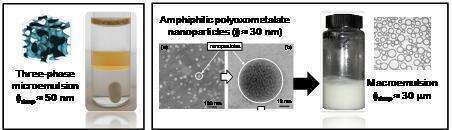
With regard to the principles of "Green Chemistry", it is necessary to develop eco-friendly catalytic processes for the activation of green oxidants such as hydrogen peroxide. However, catalytic oxidation of organic compounds by H2O2 must solve the problem of antagonist species incompatibility. One way to overcome this issue is to resort to "catalytic surfactants" which able to form nano- or microstructured reaction media such as three-phase microemulsions (mem) or "Pickering" emulsions respectively. Anionic catalysts such as molybdate or tungstate electrostatically bound to a dialkyldimethylammonium, [(Cn)2N(C1)2]2[MO4] (n = 8 to 12), form “Balanced Catalytic Surfactants” which lead to three-liquid-phase mems, called Winsor III, in the presence of water and solvent.1 Such systems are efficient for the peroxidation of olefins, dienes, aromatics, phenols, for epoxidation and sulfide oxidation in the presence of acidic amphiphiles. On the other hand, combination of the amphiphilic ammonium with a polyoxometalate (POM) provides insoluble nanoparticles which are able to stabilize emulsions. The aqueous domains (≈ 30 µm) are stabilized by spherical [Cn]3[POM] nanoparticles (» 30 nm) adsorbed at the water/solvent interface. Combination of the physicochemical properties of these “Pickering” emulsions with their ability to break on demand makes such systems of interest as oxidizing reaction media. Physicochemical characterization of the emulsions will be presented and the different parameters (i.e. nature of the POM, number and length of the alkyl chain of the ammonium, nature of the solvent, water-to-solvent ratio ….) controlling their formation will be discussed. The catalytic activity will be illustrated with the oxidation of various substrates.
1. V. Nardello-Rataj et al. J. Am. Chem. Soc. 2008, 130, 14914.
Powered by Eventact EMS