GAS PHASE STUDY OF IRON(IV)-OXO SPECIES
2Serveis Científico-Tècnics, Universitat de Girona, Girona
3Department of Organic Chemistry, Faculty of Science, Charles University in Prague, Prague 2
Iron(IV)-oxo compounds are proposed as the key intermediates in the catalytic cycles of several O2-activating non-heme iron enzymes.[1] Quite recently, high-spin (S=2) iron(IV)-oxo intermediates have been trapped and spectroscopically characterized in several different non-heme iron enzymes. Parallel synthetic efforts have succeeded in the preparation of S=2 and S=1 FeIV(O) complexes.[2] The ability of synthetic non-heme FeIV(O) species to act as oxidants has been proved and several studies demonstrate that they are capable of performing several oxidation reactions.
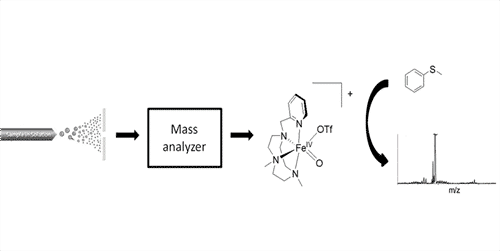
Because the vast majority of non-heme iron oxygenases contain cis-labile binding sites, synthetic iron(IV)-oxo complexes with tripodal tetradentate ligands are especially relevant from a biological point of view. However, they have proved to be less stable than their pentadentate counterparts, thus rendering their study more difficult. Some of us have recently described the preparation and spectroscopic and chemical characterization in solution of a new S=1 iron(IV)-oxo species with a tripodal tetradentate ligand that has remarkable thermal stability, especially when compared with structurally related complexes.[3] Herein, we make use of electrospray ionization to study the gas phase reactivity of this species. The mass-selected cation is capable of activating alkane C-H bonds and performs oxygen atom transfer to sulfides.
[2] L. Que Jr., Acc. Chem. Res. 2007, 40, 493.
[3] A. Company, I. Prat, J. R. Frisch, R. M. Ballesté, M. Güell, G. Juhász, X. Ribas, E. Münck, J. M. Luis, L. Que Jr., M. Costas, Chem. Eur. J. 2011, 17, 1622.
Powered by Eventact EMS