
DYNAMIC ASSEMBLY OF MOLECULARLY IMPRINTED POLYMER NANOPARTICLES
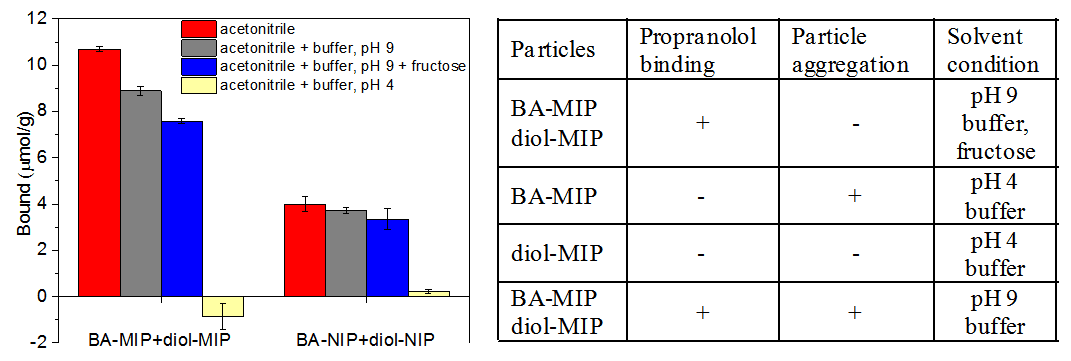
Controlling specific binding and recycling of materials are two important aspects for practical applications of molecularly imprinted polymers. In this work, we developed a new approach to control the dynamic assembly of molecularly imprinted nanoparticles by surface functionalization. Molecularly imprinted polymer nanoparticles with a well-controlled core-shell structure were synthesized using precipitation polymerization.1 The specific binding sites were created in the core during the first step imprinting reaction. In the second polymerization step, epoxide groups were introduced into the particle shell to act as an intermediate linker to immobilize phenylboronic acid,2 as well as to introduce cis-diol structures on surface.3 The imprinted polymer nanoparticles modified with boronic acid and cis-diol structures maintained high molecular binding specificity (Fig. 1A), and the nanoparticles could be induced to form dynamic particle aggregation (Fig. 1B) that responded to pH variation and chemical stimuli.4,5 In addition to recycling and reuse of precious MIP nanoparticles, the possibility of dynamic conjugation, demonstrated with the present core-shell MIP nanoparticles, also promises new chemical sensors and multifunctional materials when the MIP nanoparticles are linked to other types of reporter molecules and inorganic nanoparticles. In this work we used pH and fructose as chemical stimuli to control the nanoparticle assembly. In future development, other types of environmental triggers may also be utilized to control nanoparticle assemblies bridged by covalent or non-covalent bonds.
Figure 1. (A) Manipulation of propranolol binding by changing solvent. (B) Controlling particle aggregation and propranolol binding by varying solvent parameters.
Reference
[1] Hajizadeh, S., Xu, C., Kirsebom, H., Ye, L., Mattiasson, B. (2013) Cryogelation of molecularly imprinted nanoparticles: A macroporous structure as affinity chromatography column for removal of β-blockers from complex samples. Journal of Chromatography A 1274: 6-12.
[2] Jiang, L., Bagán, H., Kamra, T., Zhou, T., Ye, L. (2016) Nanohybrid polymer brushes on silica for bioseparation. Journal of Materials Chemistry B 4(19): 3247-3256.
[3] Jiang, L., Messing, M.E., Ye, L. (2017) Temperature and pH Dual-Responsive Core-Brush Nanocomposite for Enrichment of Glycoproteins. ACS Applied Materials & Interfaces 9(10): 8985-8995.
[4] James, T.D., Sandanayake, K.R.A., Shinkai, S. (1996) Saccharide sensing with molecular receptors based on boronic acid. Angewandte Chemie International Edition 35(17): 1910-1922.
[5] Xu, Z., Uddin, K.M.A., Kamra, T., Schnadt, J., Ye, L. (2014) Fluorescent boronic acid polymer grafted on silica particles for affinity separation of saccharides. ACS applied materials & interfaces, 6(3): 1406-1414.

Powered by Eventact EMS