
DIGITAL MIPS:
MOLECULARLY IMPRINTED POLYMERS USING PEPTIDE NUCLEIC ACID TEMPLATES FOR STORING BINARY CODES
2Pure and Applied Biochemistry, Lund University
This paper presents further developments of the concept aiming on the storage of binary codes in the imprints of molecularly imprinted polymers (MIPs). To follow nature’s prominent method to store information in nucleic acids we use peptide nucleic acid (PNA) templates in this approach. In terms of depiction of binary codes in the templates, two types of template building units are necessary to represent “1” and “0”. For this purpose, we first have to synthesize PNA building units bearing two different nucleobases (thymine = 1 and guanine = 0)1. With these units, templates with defined sequences can be generated via liquid phase synthesis2. Through the addition of functionalized, polymerizable monomers with attached template-complementary nucleobases (adenine and cytosine) and their self-assembly, an imprint can be formed through polymerisation. Using for instance a trimeric template (TGT), the resulting MIP contains its complementary sequence (ACA) as stored information (Figure 1).
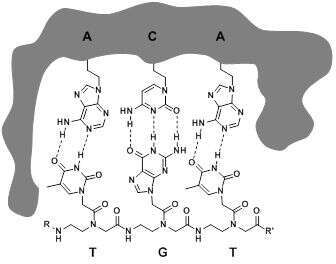
Figure 1. Concept of storing binary codes in MIP cavities. The TGT sequence (representing the binary code 101) of a peptide nucleic acid template is stored as its complementary sequence (ACA) in a molecularly imprinted polymer by applying nucleobase-functionalized monomers.
- Pothukanuri, S.; Pianowski, Z. & Winssinger, N.; Eur. J. Org. Chem. 18, 3143-3148 (2008).
- Di Giorgio, C.; Palrot, S.; Schwergold, C.; Patino, N.; Condom, R.; Farese-Di Giorgio A. & Guedj, R.; Tetrahedron. 55, 1937-1958 (1999).

Powered by Eventact EMS