
APPLICATION OF MOLECULARLY IMPRINTED POLYMERS IN COSMETICS : A NEW DEODORANT PRINCIPLE
2Research and Innovation, L’Oréal
Axillary (armpit) malodors are mainly caused by volatile medium chain branched fatty acids, produced from their non-odorant glutamine conjugate precursors by the action of bacteria, commensal to the skin. In order to combat malodors, we have synthesized a molecularly imprinted polymer (MIP) that can capture the glutamine conjugate precursors in human sweat, hence preventing their transformation into malodorous acids1 (Figure 1). The MIP, blended in a dermo-cosmetic deodorant formulation, can selectively capture the undesirable molecules in human sweat, despite the presence of a multitude of other molecules contained in this complex medium.2 The diameter of the MIP particles was around 600 nm and therefore they cannot penetrate into the skin. The biological effects of the MIP in terms of epidermal cell viability and irritation (cytotoxicity and release of proinflammatory cytokines) were assessed in vitro on human keratinocytes (HaCaT cells). Furthermore, the MIP does not affect the growth of skin bacteria (Staphylococcus epidermidis, Corynebacterium Striatum and Micrococcus luteus) isolated from human sweat, indicating that the MIP will not perturb the fragile microbial equilibrium of the skin.3 This innovative application of MIPs meets the needs of cosmetic industries in the development of mild deodorant active ingredients as alternatives to the currently-used unspecific antimicrobials, hence preserving the integrity of the skin microbiota.
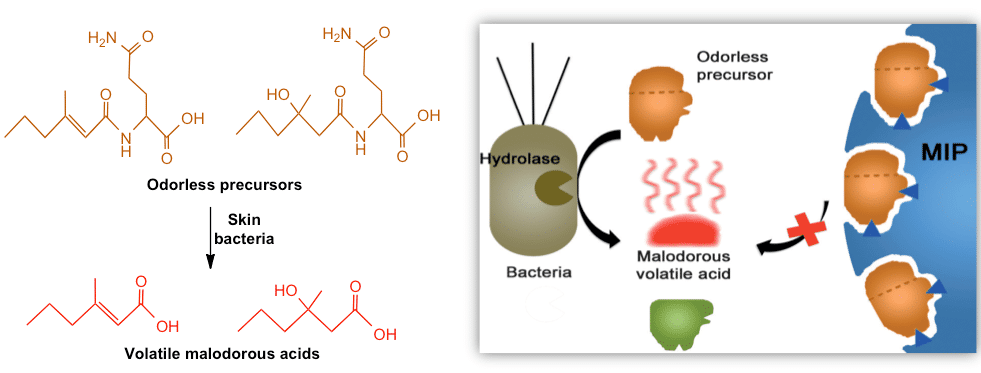
Figure 1. Formation of volatile malodorous acids from their non-odorant glutamine conjugates by skin bacteria in axillary sweat (left); capture of the odorless precursors by MIP, preventing the bacteria to convert them to malodorous acids (right).
[1] Greaves A., Manfre F., Haupt K., Tse Sum Bui B. (2014) Molecularly imprinted polymer for trapping odorous molecules. Patent WO 2014102077 A1
[2] Nestora S., Merlier F., Beyazit S., Prost E., Duma L., Baril B., Greaves A., Haupt K., Tse Sum Bui B. (2016) Plastic antibodies for cosmetics: Molecularly imprinted polymers scavenge precursors of malodors. Angew. Chem. Int. Ed. 55: 6252-6256
[3] Callewaert C., Hutapea P., Van de Wiele T., Boon N. (2014) Deodorants and antiperspirants affect the axillary bacterial Community. Arch. Dermatol. Res. 306 : 701-710

Powered by Eventact EMS