
MOLECULAR IMPRINTING ON PROTEINS USING TAILOR-MADE AFFINITY MONOMERS
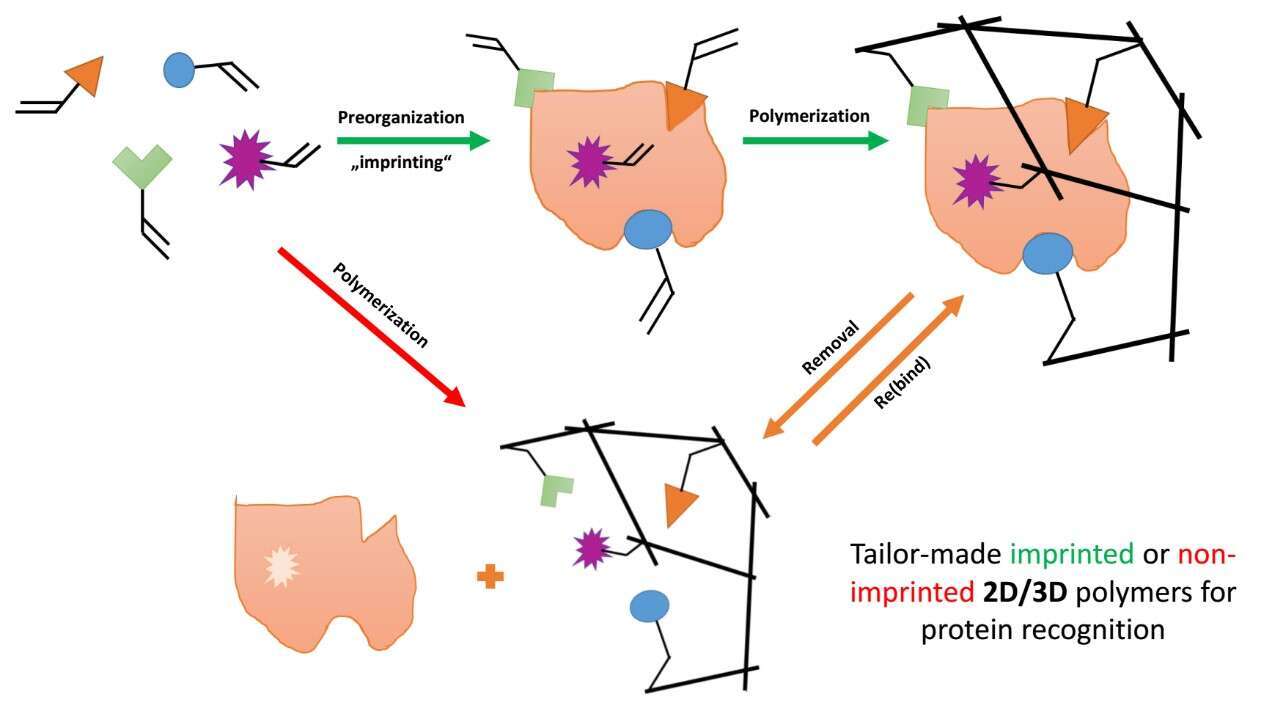
During the past two decades, there was an exponential increase of research containing molecular imprinted materials. It started from ions to small molecules over peptides and finally reached macromolecules and proteins, viruses, DNA and cells. The field of protein imprinting and recognition is just about to be further investigated and developed.[1] We faced up to this challenging task and developed tailor-made molecular non-imprinted (NIP) and imprinted (MIP) polymers in two versions, hydrogels and nanoparticles. In contrast to literature, we use special designed and synthesized monomer library to create a specific polymer for a certain target. With the help of the amino acid complementary monomers, we want to enable a design of highly specific and selective polymers which can e.g. block protein or enzymatic functions, hinder protein-protein interactions or act like synthetic antibodies.[2] The high affinity of our two main functional monomers could be demonstrated also in imprinted biosensors for trypsin with a detection limit below picomolar (pM) concentrations.[3]
References:
- M. E. Byrne, V. Saliam: Review, Int. Journal of Pharmaceutics; 2008, 364, 188–212.
- Y. Hoshino, H. Koide, T. Urakami, H. Kanazawa, T. Kodama, N. Oku, K. Shea: Recognition, Neutralization, and Clearance of Target Peptides in the Bloodstream of Living Mice by Molecularly Imprinted Polymer Nanoparticles: A Plastic Antibody, JACS; 2010, 132, 6644–6645.
- G. Ertürk, M. Akhoundian, K. Kujawski, S. Shinde, S. Y. Yeung, M. Hedström, T. Schrader, B. Mattiasson, B. Sellegren: Ultrasensitive Protein Sensor Based on Microcontact Imprinting – Complementary Match of Supramolecular and Dynamic Chemistry, 2018, submitted.

Powered by Eventact EMS