
SMART IMPRINTED POLYMERS FOR THE THERAPEUTIC MONITORING OF CHEMOTHERAPEUTICS
2Dipartimento di Scienze Chimiche e Farmaceutiche, Università degli Studi di Trieste
Tyrosine Kinase Inhibitors, such as Imatinib mesylate, are a class of anticancer drugs that would benefit from therapeutic drug monitoring (TDM) due to their high inter-patient variability in terms of efficacy.1 TDM is the measurement and interpretation of drug concentrations in biological fluids and can contribute to personalised drug dosing. There is a growing need for simple methods that allow for the quantification of drugs concentrations in blood-plasma; current analysis methods, such as HPLC-UV and LC-MS, provide reliable data but require expensive equipment, extensive sample preparation and skilled operatives.2
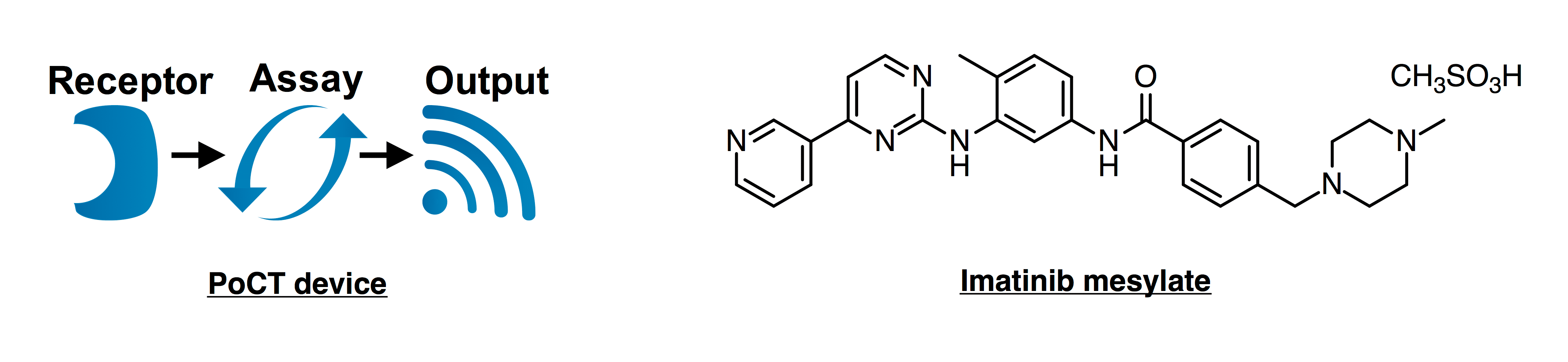
As part of a collaborative project between Queen Mary University of London, Università degli Studi di Trieste and Centro di Riferimento Oncologico Aviano, imprinted nanogels are being developed as artificial receptors to be used in a point of care testing (PoCT) device. The aim of the work is to selectively bind the anticancer drug Imatinib from human blood/plasma. This device would be cheaper, easier to operate and provide quicker diagnostics than the current TDM analysis methods. Previous work has been done on the selective binding of anticancer drugs using nanogels,3 but to-date no PoCT device exists for the detection of Imatinib in blood/plasma.
In order to facilitate a strong pre-polymerisation complex and the formation of nanogels capable of selectively binding Imatinib, a variety of monomers have been screened through 1H NMR binding interactions studies to identify the ones that have a strong non-covalent affinity towards Imatinib. 2-acrylamido-2-methyl-1-propanesulfonic acid (AMPS) was identified as the most promising functional monomer. We hypothesise that a contact-ion complex can be formed, in DMSO, with a primary electrostatic interaction between the AMPS sulfonic acid group and Imatinib piperazine group; Ka = 2731.53 ± 866.08 M-1, with possible smaller secondary interactions with the Imatinib amine and pyridine groups. Nanogels were synthesised through free radical polymerisation and were optimised through 1H NMR monitoring of monomer conversion; using 1 % monomer concentration with 5 % initiator for a polymerisation time of 24 h produced small nanogels (70-80 nm) with high monomer conversions and polymer yields (>80 %). Preliminary studies show partial rebinding of Imatinib by the nanogels.
With these nanogel receptors alongside a spectrophotometric assay we have been optimising, there is promise for a point of care testing device with a detection limit useful for the therapeutic monitoring of Imatinib.
[1] Picard S, Titier K, Etienne G, Teilhet E, Ducint D, Lassalle R, Marit G, Reiffers J, Begaud B, Moore N, Bernard M, Molimard M, Mahon F (2007) Trough Imatinib plasma levels are associated with both cytogenic and molecular responses to standard-dose Imatinib in chronic myeloid leukaemia. Blood 109(8): 3496-3499
[2] Polo F, Toffolli G (2016) Point-of-Care for Therapeutic Drug Monitoring of Antineoplastic Drugs. Med Chem (Los Angeles) 6(6)
[3] Pellizzoni E, Tommasini M, Marangon E, Rizzolio F, Saito G, Benedetti F, Toffoli G, Resmini M, Berti F (2016) Fluorescent molecularly imprinted nanogels for the detection of anticancer drugs in human plasma. Biosensors and Bioelectronics 86: 913-919

Powered by Eventact EMS