
CU(II)-BASED IMPRINTED NANOGELS AS ARTIFICIAL RECEPTORS FOR CHLOROGENIC ACID
2Dipartamento di Scienze Chimiche e Farmaceutiche, Università degli Studi di Trieste
Coffee is one of the most popular beverages worldwide and its production represents a giant global industry [1]. One of the most important compounds in coffee is chlorogenic acids, which are known for their beneficial antioxidant characteristics, are an important indicator of coffee quality and directly affect the flavour and aroma of the coffee. Therefore, the development of a reliable, rapid and simple method for the specific detection and quantification of CGAs, using the molecular imprinting methodology, is of great interest to the area of quality control in coffee and considering its beneficial health character, could be of great importance to the food safety industry.
Given that in molecular imprinting the pre-polymerisation complex is a key parameter in determining the final selectivity and specificity of the imprinted polymer, the pre-polymerisation complex was studied. Hereupon, a series of functional monomers were tested and their non-covalent interactions with CGAs studied using a computational protocol, based on density functional theory. The most promising functional monomers were then synthesised and their interaction with 5-caffeoylquinic acid (5-CQA) evaluated using several spectroscopic techniques. As result of this study, a copper (II) complex that is able to give specific binding to the 5-CQA has been identified. This complex was studied by electron paramagnetic resonance (EPR) and UV-Vis spectroscopy, which can be used as part of a spectrophotometric assay due to its optical properties (Figure 1).
High-dilution radical polymerisation method [2] was used for the synthesis of the imprinted nanogels, in which considerable work was invested for the obtainment of nanogels and in optimisation of the polymerisation conditions, studying the monomer conversion using 1H-NMR. The final imprinted nanogels were obtained in high yields (>80%) and with a particle size around 130 nm. Rebinding studies were carried out using UV-Vis spectroscopy and the data obtained so far are promising.
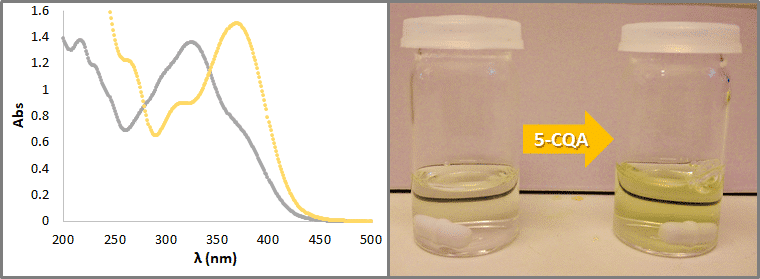
Figure 1 – a) Spectra o the free 5-CQA (grey) and 5-CQA complexed with copper (II) (yellow); b) Colour change of the polymeric solution when 5-CQA is added.
[1] Butt M, Sultan M (2011) Coffee and its Consumption: Benefits and Risks. Critical Reviews in Food Science Nutrition 51: 363-373
[2] Graham N, Hayes C (1995) Microgels 1: Solution polymerization using vinyl monomers. Macromolecular Symposia 93: 293-300

Powered by Eventact EMS