
SELF-REPORTING MOLECULARLY IMPRINTED POLYMER
FOR LABEL-FREE SELECTIVE ELECTROCHEMICAL SENSING
OF P-SYNEPHRINE
2Department of Chemistry, University of North Texas
3Faculty of Mathematics and Natural Sciences, School of Exact Sciences, Cardinal Stefan Wyszynski University in Warsaw
Molecularly imprinted polymers (MIPs) are excellent examples of bio-mimicking recognition materials.1 They have found numerous applications in selective chemosensing. For electrochemical determination of electroinactive analytes, usually some external redox probe is added to the sample solutions. It is assumed that binding of target analyte molecules by MIP molecular cavities causes MIP film swelling or shrinking. This behavior leads to changes in MIP film permittivity for the redox probe and thus changes in faradaic currents (so called “gate effect”) in CV and DPV determinations.2
However, this mechanism seems to be inadequate for electrochemical sensors with conductive MIP film recognition units.3 If analyte binding to an MIP film does not affect redox probe diffusion to the electrode surface, one can speculate that diffusion of this probe is not a crucial issue in terms of selective determination with the MIP film coated electrode. Therefore, a new specially designed monomer, vis., p-bis(2,2`-bithien-5-yl)methyl-ferrocene benzene, was used for deposition of a self-reporting MIP film. This monomer acted as both a cross-linking monomer and an internal redox probe. It was electropolymerized together with 2,2`-bitiofen-5-carboxylic acid in the presence of the p-synephrine template – a diet supplement that is suspected of causing serious cardiovascular diseases. These self-reporting MIP film modified electrode was successfully used for electrochemical determination of p-synephrine in the absence of an external redox probe.
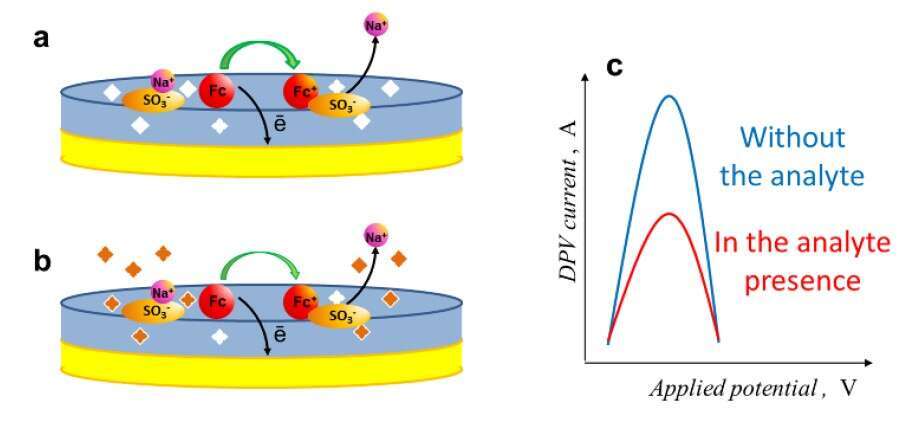
Scheme 1. Principle of operation of self-reporting MIP recognition layer based chemosensor in (a) absence and (b) presence of a target analyte, and (c) analytical DPV signal.
References
[1] Cieplak M., Kutner W. (2016) Artificial Biosensors: How Can Molecular Imprinting Mimic Biorecognition? Trends Biotechnol. 34: 922-941.
[2] Yoshimi Y., Sato K., Ohshima M., Piletska E. (2013) Application of the ‘gate effect’ of a molecularly imprinted polymer grafted on an electrode for the real-time sensing of heparin in blood. Analyst 138: 5121-5128.
[3] Lach P., Sharma P. S., Golebiewska K., Cieplak M., D’Souza F., Kutner W. (2017) Molecularly Imprinted Polymer Chemosensor for Selective Determination of an N-Nitroso-L-proline Food Toxin. Chem. Eur. J. 23: 1942-1949.

Powered by Eventact EMS