
AF Rotor Identification (Ablation?)
Ablation is an established method to treat atrial fibrillation (AF). The exact extent of the ablation procedure- especially in non-paroxysmal AF- is however still debatable.
While pulmonary veins isolation (PVI) is agreed to be the cornerstone in general practice, but it still has a limited success rate. Other strategies of additional ablations have not proved more efficacious than PVI alone. We propose a new, more accurate a method, to detect rotors that freely propagate in the heart tissue during atrial fibrillation.
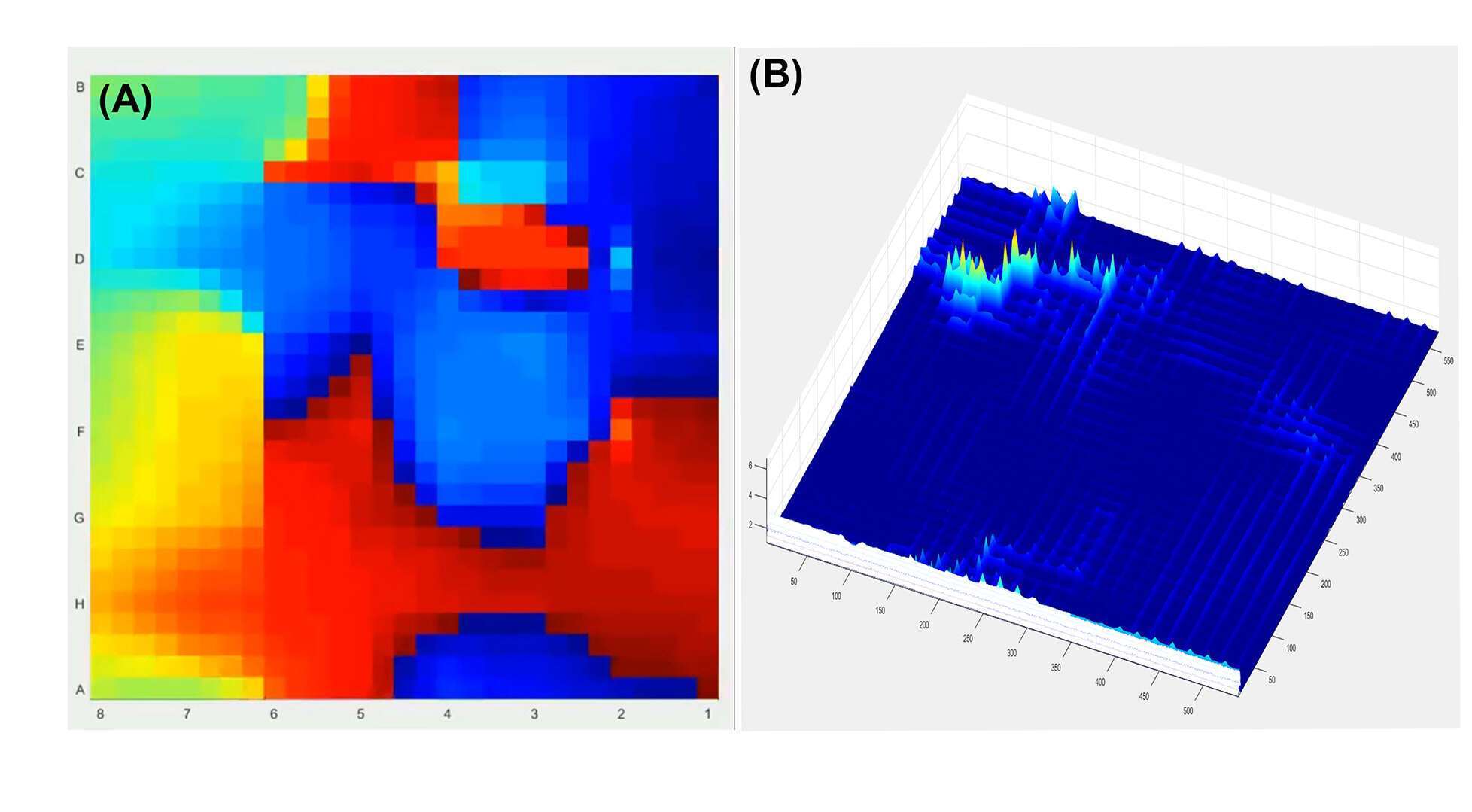
We use a known mathematical analysis, adapted by us to the specific heart problem, on videos of local electrical activity and propagation during AF, to pinpoint the course taken by the rotor`s center during AF. We present our results on a video obtained by 64 "basket" electrodes from a patient. In the video itself, the spiral movement is barely observed (see Fig. 1A, supplementary material). Our analysis consists of: the application of a "singular value decomposition" which derives the most important modes of the phenomenon; reconstruction of the latter by the highest modes, thus hugely enhancing its resolution, sharpness and accuracy; application of Hilbert transformation to derive the positions of the rotor-center with time; and finally averaging these positions to derive the path that this center has visited (see Fig. 1B supplementary material).
We believe that ablation along this AF propagation rotor path should be investigated as a mean to enhance success rate of AF ablation.
Powered by Eventact EMS