
A study of imprint and wakeup in ferroelectric Al1-xScxN
2Institute for Electrical and Information Engineering, Kiel University, Kiel, Germany
3Institute for Silicon Technology, Fraunhofer, Itzehoe, Germany
Imprint and wakeup are fundamental processes in ferroelectric materials, whose understanding can contribute significantly to device functionality, e.g. in the case of ferroelectric memories. To understand and control both effects in the new wurtzite-type ferroelectrics would therefore be highly desirable.
For N-polar Al1-xScxN, our study suggests that there is no wakeup effect that changes the overall structure of the wurtzite-type crystal in a significant way, as the full remanent polarization can be already obtained during the first voltage pulse. Instead, a shift in the imprint of our capacitors can lead to a wakeup-like effect if the initial voltage pulse is below the initial negative coercive field [Figure 1]. By I-V measurements on Al1-xScxN films deposited in between two Platinum electrodes we found, that the imprint can shift strongly over a number of cycles before it stagnates. The amount of this shift depends on the polarity of the applied signal.
Similarly, thermal annealing is found to be an effective way to change the imprint from negative values at room temperatures and even reach positive imprint at 600°C, depending on the polarization state that was previously inscribed on the capacitors. XPS and TOF-MS are used to establish a connection between these electrical measurements and the chemical composition of our samples.
Like in other ferroelectrics, we thick that the origin of Imprint in Al1-xScxN could lie in the alignment or migration of charged defects like vacancies inside the ferroelectric layer, which lead to a shifted polarization curve.
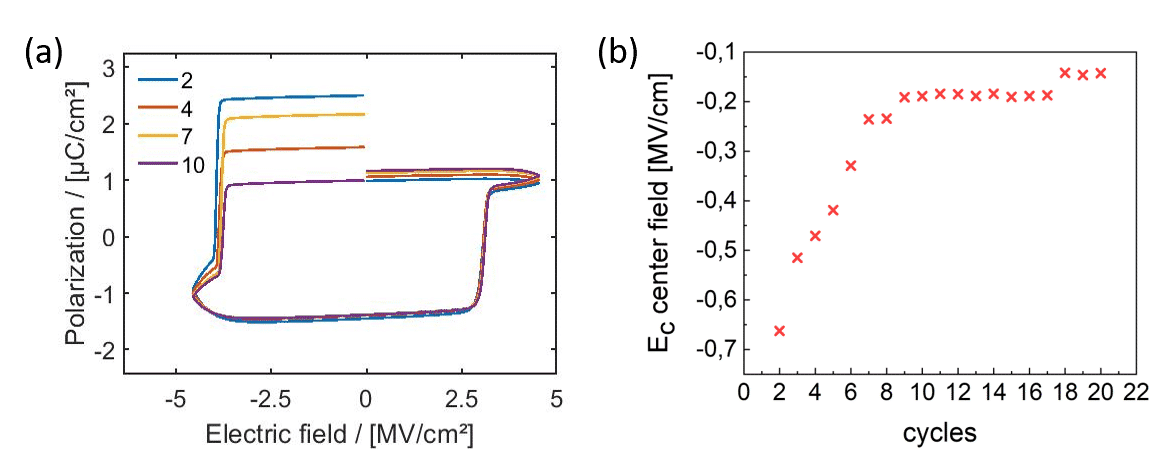
Figure 1: (a) Polarization curve of Al62Sc38N over number of cycles (b) (|Ec+| - |Ec-|) of Al62Sc38N over number of cycles.

Powered by Eventact EMS