A DELPHI CONSULTATION ON CRITERIA SUPPORTING THE DECISION TO REFER PREGNANT WOMEN FROM A PRIMARY CARE PROVIDER TO A SPECIALIST DURING ANTENAL FOLLOW-UP
Problem statement: In Belgium, primary care follow-up is permitted for low-risk pregnancies, but practitioners lack guidelines on when to refer patients to obstetrics and gynecology specialists. Our objective was to develop a Belgian tool to assist primary-care practitioners in making appropriate referrals.
Methodology: We conducted a modified Delphi consultation to establish consensus. We gathered a panel of 30 healthcare professionals with extensive experience in antenatal follow-up, including equally gynecologists, midwives, and general practitioners. Using existing literature, we selected five "referral actions" (actions to be taken by the primary-care practitioner in response to a given situation) and 153 "criteria"(relevant clinical and non-clinical situations that may arise during pregnancy). The Delphi panel underwent six rounds of written consultation and three online meetings. Comments on previous rounds were anonymously analyzed and reported to support the next rounds or discussions. Online meetings were held to discuss relevant comments, which were confirmed in subsequent written rounds. Consensus was set at 75%, with items receiving 25% of votes or less being excluded.
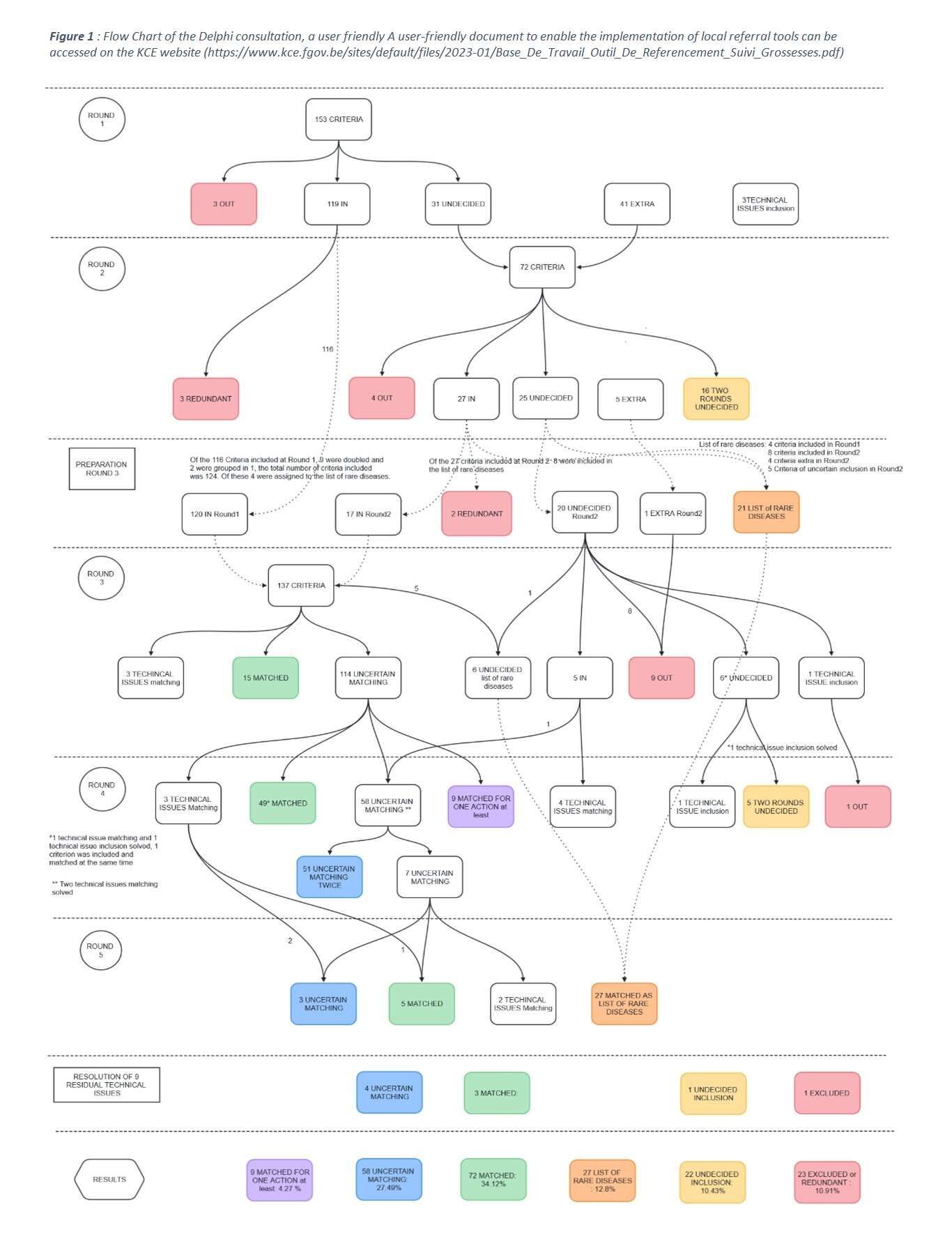
Results: The panel achieved consensus on four referral actions: antenatal follow-up in primary care, specialist`s advice, referral to a specialist, and emergency referral. From the initial 153 criteria, 41 were added after the first round, five more after the second round. Across five rounds, 23 criteria (10.91%) were excluded or considered redundant, while 22 criteria (10.43%) lacked consensus on inclusion or exclusion. Additionally, 27 criteria (12.8%) were categorized as "rare diseases." For 58 criteria (27.49%), there was agreement on inclusion, but no referral action reached the consensus threshold. In nine cases (4.27%), agreement was reached on inclusion for one referral action, but another action did not meet the threshold. Finally, 72 criteria (34.12%) were successfully matched with a referral action. For an overview of the Delphi rounds, refer to Figure 1.
Conclusions: While the Delphi panel did not reach complete consensus on the content of a comprehensive Belgian tool, agreement was achieved on 72 criteria, providing a common framework for the development of local referral tools. A user-friendly document to enable the implementation of local referral tools can be accessed on the KCE website