
Distinct Patterns of Moderate-to-Vigorous Intensity Physical Activity Before and After Cardiovascular Disease: Insights from the CARDIA Study
2School of Public Health, University of Alabama at Birmingham, USA
3School of Public Health, University of Minnesota, USA
4National Heart, Lung, and Blood Institute, National Institutes of Health, USA
5Department of Preventive Medicine, Northwestern University Feinberg School of Medicine, USA
6Division of Research, Kaiser Permanente Northern California, USA
Introduction: Few longitudinal studies have tracked moderate-to-vigorous intensity physical activity (MVPA) before and after cardiovascular disease (CVD) events. This study leverages 35 years of repeated MVPA assessments from the Coronary Artery Risk Development in Young Adults (CARDIA) cohort to evaluate long-term MVPA trajectories and changes surrounding CVD events.
Methods: The study employed two complementary designs: (1) a cohort analysis (n=3,068), including 529 Black men, 796 White men, 834 Black women, and 909 White women, to examine long-term MVPA trajectories across adulthood, and (2) a nested case-control analysis (n=472) to assess MVPA before and after CVD events (CHD, stroke, and heart failure). CVD-free controls were matched 1:1 to incident (first-ever) cases by age, sex, and race using risk-set sampling. MVPA was assessed up to 10 times between 1985 and 2022 using the validated CARDIA Physical Activity History Questionnaire, with scores expressed in exercise units (EU), where 300 EU approximates 150 minutes/week of moderate PA. LOESS regression modeled MVPA trajectories, while Generalized Estimating Equations derived the odds ratio (OR) of low MVPA (<300 EU) post-CVD, adjusting for baseline MVPA.
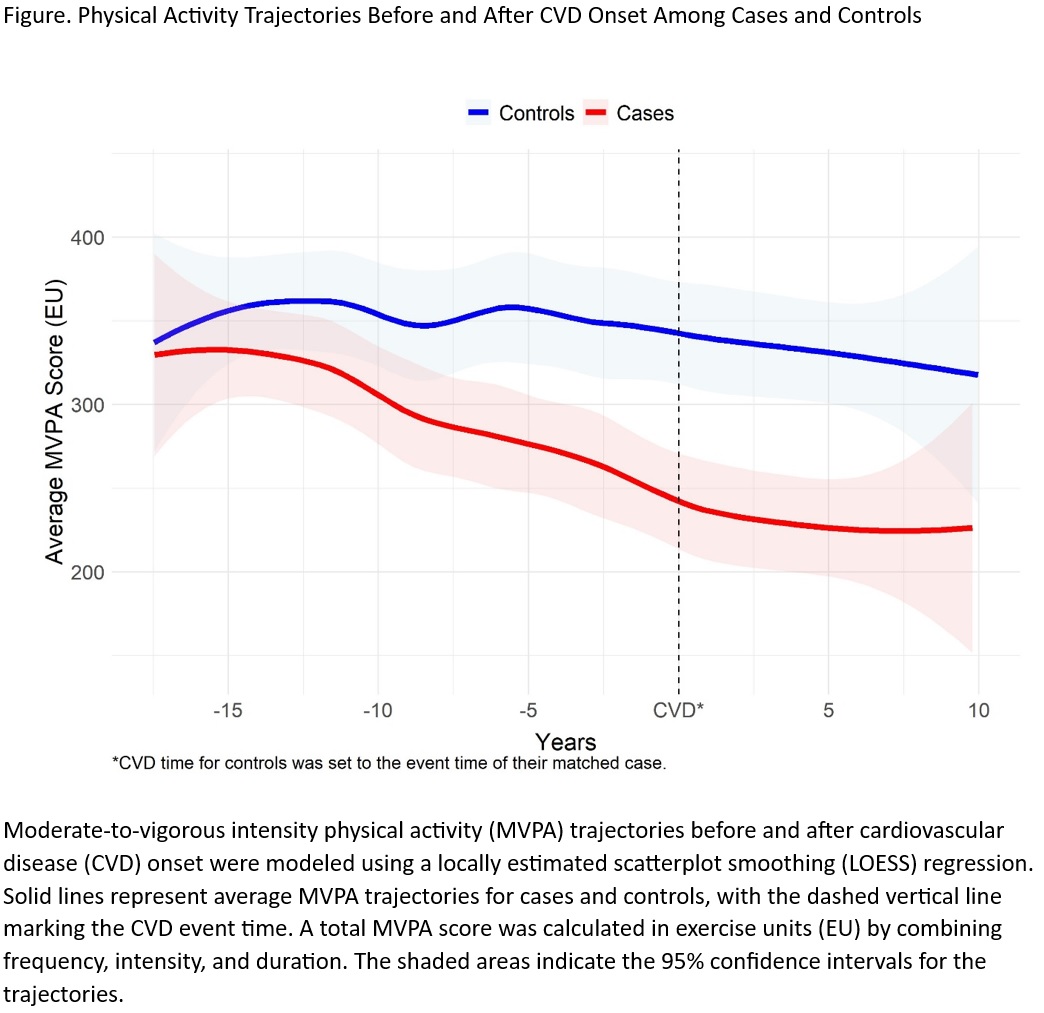
Results: In the cohort analysis, overall MVPA levels declined from ages 18 to midlife, then stabilized through later adulthood. Black men experienced the steepest decline. In the nested analysis, MVPA in cases began declining approximately 12 years before CVD onset, accelerating within 2 years of the event. Following CVD onset, the gap in MVPA between cases and controls widened (p = .002; Figure). The adjusted OR for low post-CVD MVPA in cases versus controls was 1.78 (95% CI: 1.26–2.50), with Black women showing the highest risk (OR = 4.52; 95% CI: 2.29–8.89).
Conclusions: MVPA declines begin over a decade before CVD onset and persist post-event. This study underscores the need for targeted interventions to promote MVPA adherence across adulthood and address disparities in MVPA that widen following CVD. Long-term, repeated assessments of MVPA are essential to inform preventive and rehabilitative strategies.
israelheart@ortra.com מייל לשאלות
