
Palliative care utilization in patients with advanced heart failure and its associations with end-of-life outcomes
2Internal Medicine B, Tel-Aviv Sourasky Medical Center, Tel Aviv, Israel, Israel
3Lung Institute, Tel-Aviv Sourasky Medical Center, Tel Aviv, Israel, Israel
4Faculty of Medicine, Tel Aviv University, Tel Aviv, Israel, Israel
Introduction:
Although palliative care should be part of the management of people with advanced chronic illnesses (ACI), including heart failure (HF) it is generally underused. We sought to evaluate the prevalence, determinants, and associations with outcomes of palliative care utilization (PCU) in patients with HF and to compare them with chronic obstructive pulmonary disease (COPD) and malignancy patients.
Materials and Methods:
We conducted a prospective observational study including hospitalized subjects with, advanced heart failure, severe COPD and metastatic malignancy. Subjects were interviewed regarding their demographic status, overall health, PCU, and end-of-life decisions.
Results:
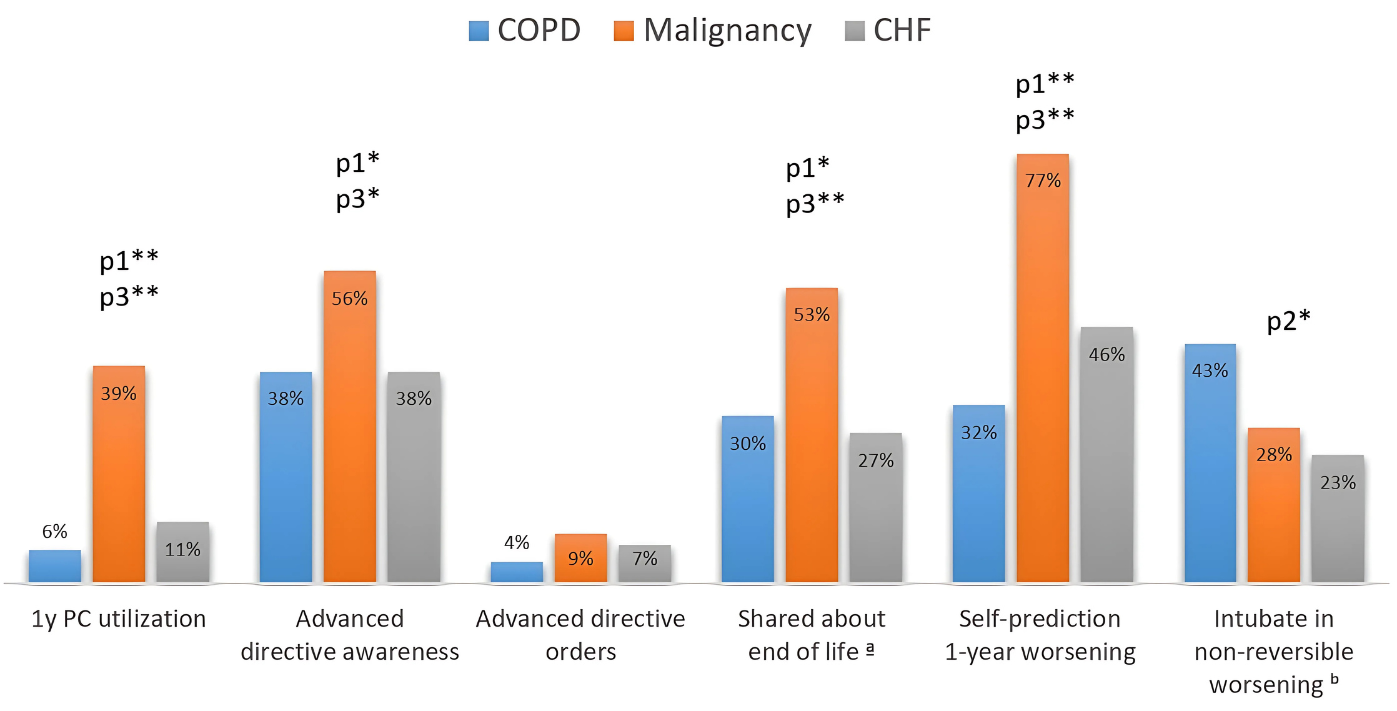
A total of 166 subjects were included (median age:77 years; 41% females). Participants had a 1-year median of 2 admissions. Subjects with HF (n=56) and COPD (n=53) and had low rates of PCU compared to those with malignancy (n=57) (11% and 6% vs. 39%, respectively; p<0.01). PCU occurred only in patients who visited a specialist prior to study inclusion. Subjects with PCU were more aware of advance directives (71% vs. 38%), signed advanced orders (23% vs. 3%), and shared their end-of-life decisions with others (71% vs. 29%). These associations remained significant after adjustment for prior specialist visits. Independent predictors for PCU were self-definition as non-religious (adjusted OR 3.41, 95% CI 1.2-9.9), above high-school education (AOR 2.84, 95% CI 1.1-7.3), and chronic pain (aOR 2.81, 95% CI 1.11-7.14), while COPD showed the opposite (aOR 0.25, 95% CI 0.07-0.96).
Conclusion:
Palliative care utilization is low among patients with HF and COPD and has an impact on end-of-life decisions. HF and COPD specialists` involvement can help inform patients in end-of-life management options.
israelheart@ortra.com מייל לשאלות
