
Age cutoff associated with increased mortality and long-term survival in patients undergoing contemporary transcatheter aortic valve replacement- A multi-center cohort study
2Faculty of Medicine, Tel Aviv University, Tel Aviv, Israel, Israel
3Lung Institute, Tel-Aviv Sourasky Medical Center, Tel Aviv, Israel, Israel
Introduction
Along with comorbidities, anatomical suitability, and prostheses durability, age remains a critical factor in the decision-making process for the lifelong management of patients with symptomatic severe aortic stenosis (AS). We sought to evaluate the association between age and long-term survival in patients with symptomatic severe AS undergoing TAVR, based on data from the Israeli National TAVR Registry.
Methods
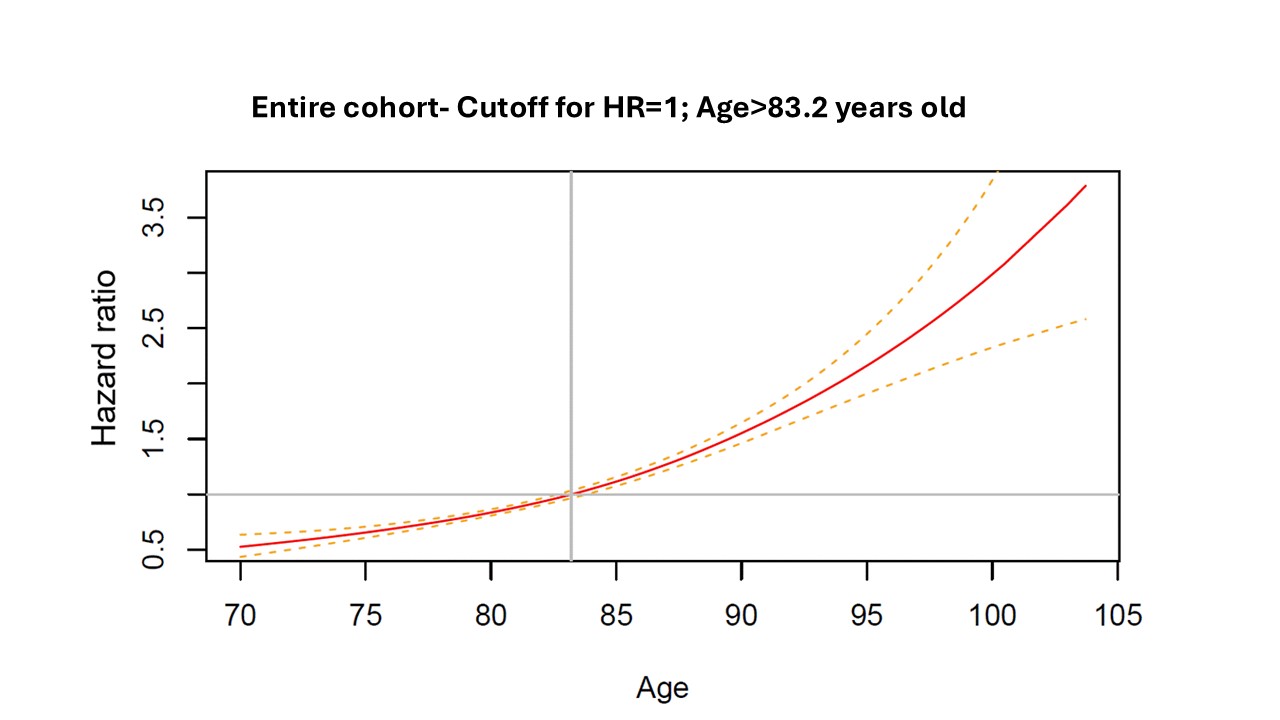
We conducted a retrospective analysis of patients who underwent TAVR at the six largest Israeli referral centers between March 2011 and February 2018. The correlation between age at the time of TAVR and 10-year survival was estimated using restricted cubic spline regression and multivariable Cox regression analysis.
Results
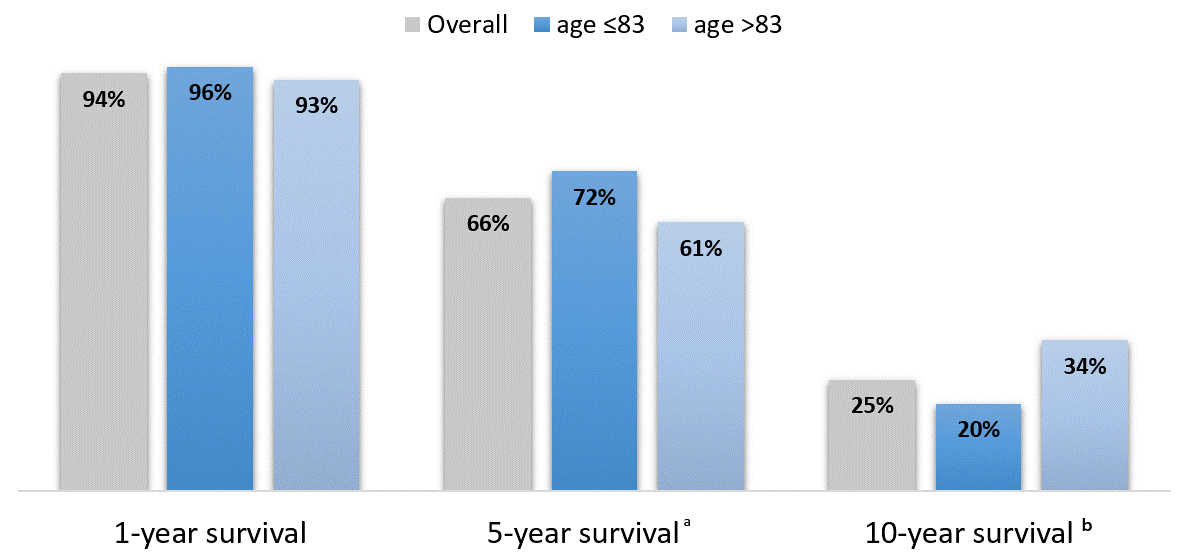
We included 6191 patients with severe AS in the analysis (51% Females; mean age 82.7±5.4 y/o). Cubic spline analysis pointed at 83 y/o as the age threshold correlating with increased mortality. The 1, 5 and 10-year survival in patients aged ≤ 83y/o was 96%, 72% and 20%, compared to 93%, 61% and 34% in older patients. Median survival time of patients ≤ 83y/o and >83y/o was 6.9 years (95% confidence interval (CI) 1.22-1.45) and 5.4 years (95% CI 5.1-5.7), respectively (p<0.001). Kaplan-Meier curves showed that 10-year mortality was significantly higher in patients older than 83 (HR 1.35, 95% CI 1.22-1.45, p<0.01). In a multivariate analysis adjusted for baseline and echocardiographic characteristics, age >83 y/o (HR 1.52, 95% CI 1.37-1.68 ; p<0.001), increasing NYHA class (HR 1.30, 95% CI 1.21-1.41; p<0.001) and increasing STS score (HR 1.05, 95% CI 1.03-1.07; p<0.001) was associated with increased 10-year mortality.
Conclusion
In patients undergoing TAVR, age older than 83 years represents a cutoff age associated with increased long-term mortality. This threshold may be considered as part of the heart team`s decision-making process for the long-term management of patients with severe AS.
israelheart@ortra.com מייל לשאלות
