
Tricuspid annular plane systolic excursion- systolic pulmonary artery pressure ratio associated with increased mortality in an all-comer population
2Faculty of Medicine, Tel Aviv University, Tel Aviv, Israel, Israel
3Lung Institute, Tel-Aviv Sourasky Medical Center, Tel Aviv, Israel, Israel
4Cardiology, Tulane University, USA
Introduction
Tricuspid-annular-plane-systolic-excursion (TAPSE)- systolic pulmonary artery pressure (sPAP) ratio is an emerging parameter of right-ventricle and pulmonary circulation coupling. The abnormality threshold of this parameter in consecutive patients is unknown. We aimed to elucidate the abnormality threshold of this parameter based on its association with mortality in consecutive patients.
Materials and Methods
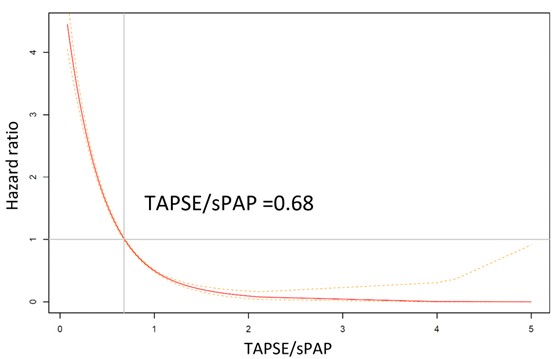
We performed a retrospective analysis of consecutive patients undergoing echocardiography in a single tertiary center between 2011-2021. TAPSE was measured using M-mode and sPAP was calculated by summing tricuspid valve pressure gradient and right atrium pressure. Cut-off values associated with excess mortality were assessed using spline curves in univariate, and multivariate Cox analyses.
Results
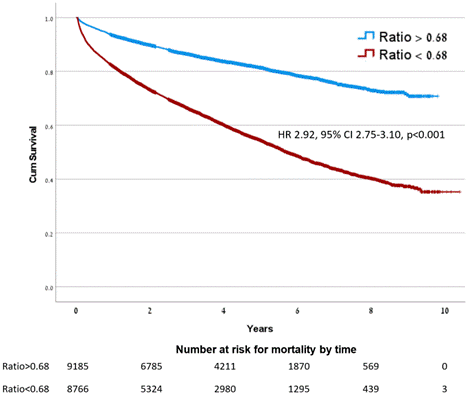
A total of 17951 subjects were included in the current analysis (47% females; median age: 71 y/o). Median TAPSE and sPAP were 21mm (interquartile range [IQR]: 18-25) and 31mmHg (26-41), respectively. A TAPSE-sPAP ratio of <0.68 mm/mmHg was associated with excess mortality. In sub-group analysis, among patients with and without cardiovascular comorbidities, a ratio of <0.53 and <0.79 mm/mmHg, respectively, was associated with excess mortality. In a multivariate model adjusted for baseline and echocardiographic characteristics TAPSE-sPAP ratio <0.68 mm/mmHg was independently associated with increased mortality (Hazard ratio 1.52, 95% confidence interval 1.42-1.63; p<0.001).
Conclusion
Excess mortality is seen at higher TAPSE/sPAP values than previously described. The TAPSE/sPAP cutoff associated with excess mortality was lower in patients with compared to without cardiovascular comorbidities, emphasizing that a patient tailored approach is needed when assessing the prognostic role of this parameter.
israelheart@ortra.com מייל לשאלות
