
Left-ventricle global longitudinal strain and coronary microvascular dysfunction in patients with preserved ejection fraction- A single center study
2Faculty of Medicine, Tel Aviv University, Tel Aviv, Israel, Israel
3Lung Institute, Tel-Aviv Sourasky Medical Center, Tel Aviv, Israel, Israel
Introduction
Left ventricle global longitudinal strain (LVGLS) can detect early, subclinical myocardial injury. Reduced LVGLS is associated with worse clinical outcomes in several cardiovascular conditions. Whether LVGLS is reduced in patients with coronary microvascular dysfunction is currently unknown.
Materials and Methods
This study included patients with non-obstructive CAD undergoing clinically indicated invasive assessment of coronary microvascular function between November 2019 and October 2024 with ejection fraction (EF) >50%. LVGLS measurement was performed using a semi-automated tracking software. Associations between LVGLS, echocardiographic parameters[MK1] and coronary microvascular function, were assessed using univariate and multivariate regression models.
Results
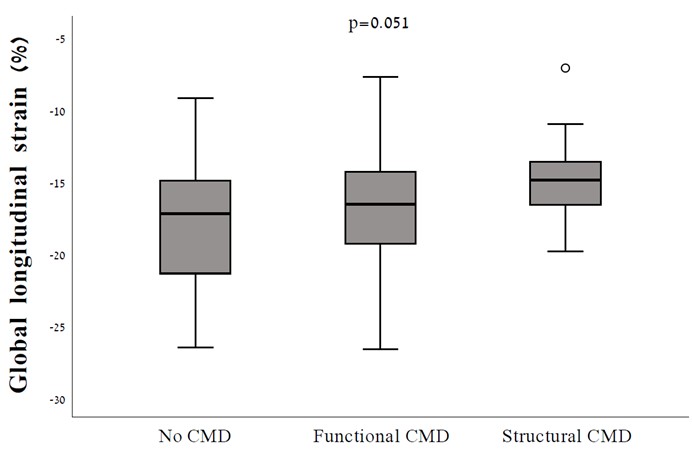
Overall, 75 patients were included in the analysis (57% female; median age 65 (interquartile range [IQR]: 56, 73) of which 40 (53%) had evidence of coronary microvascular dysfunction. Median EF was 60% in both groups. Patients with CMD had numerically lower LVGLS compared to patients without CMD (-16% [IQR: -18, -14] vs. -17.3% [IQR: -22, -15; p=0.06). Patients with structural CMD (-14.9%; -16.7, -13.7) vs. functional CMD (-16.6%; -19.4, -14.4), and no CMD (-17.6%; IQR: -21.6, -15.2) had [MK2] lower LVGLS (P for trend=0.051. In a multivariate analysis, reduced LVGLS (<17.5%) was found to be independently associated with CMD (adjusted odds ratio: 3.6; 95% confidence interval: 1.18-11; p=0.025).
Conclusion
Patients with CMD and preserved ejection function have lower LVGLS compared to patients without CMD, with a trend towards worse LVGLS among patients with structural versus functional and no CMD. Reduced LVGLS might emerge as an early non-invasive clinical marker for coronary microvascular dysfunction.
israelheart@ortra.com מייל לשאלות
