
The prognostic impact of remnant cholesterol on myocardial infarction and coronary revascularization following acute ischemic stroke
2Faculty of Medicine, Technion, Israel Institute of Medicine, Haifa, Israel, Israel
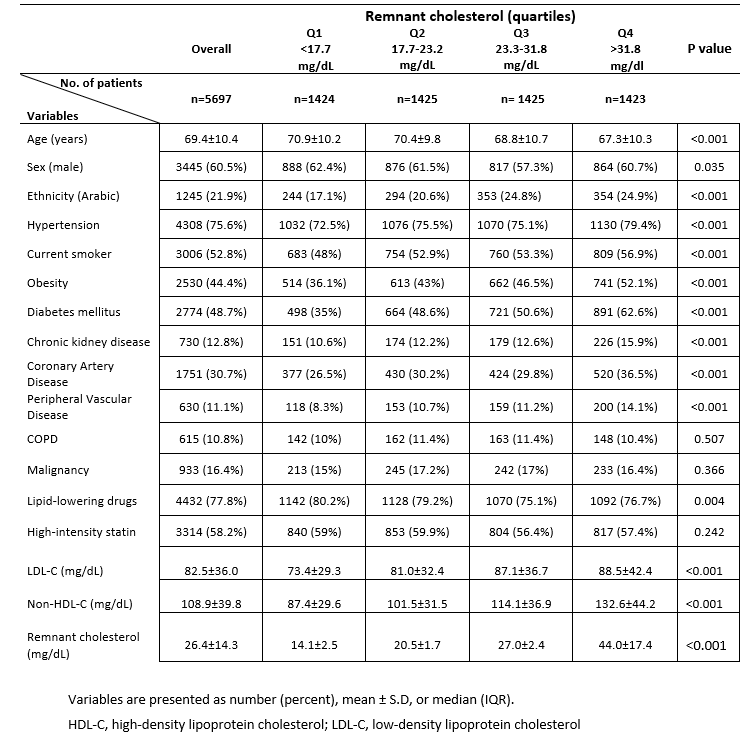
Background: Remnant cholesterol (RC), the cholesterol content of triglyceride-rich lipoproteins, is an emerging residual risk factor for atherosclerotic cardiovascular disease. Data on the prognostic significance of RC in patients with ischemic stroke is limited. We aimed to investigate the association between RC and risk for myocardial infarction (MI) or coronary revascularization following hospitalization with an ischemic stroke.
Methods: Data on 5697 patients from a national health-care service hospitalized with an acute ischemic stroke. Adjusted Cox-regression models were used to estimate the association between RC percentiles, calculated using a routine post-discharge lipid profile, and risk for future MI or revascularization. Discordance analysis was used to examine the correlation between RC and non- HDL-C in relation to cardiac risk.
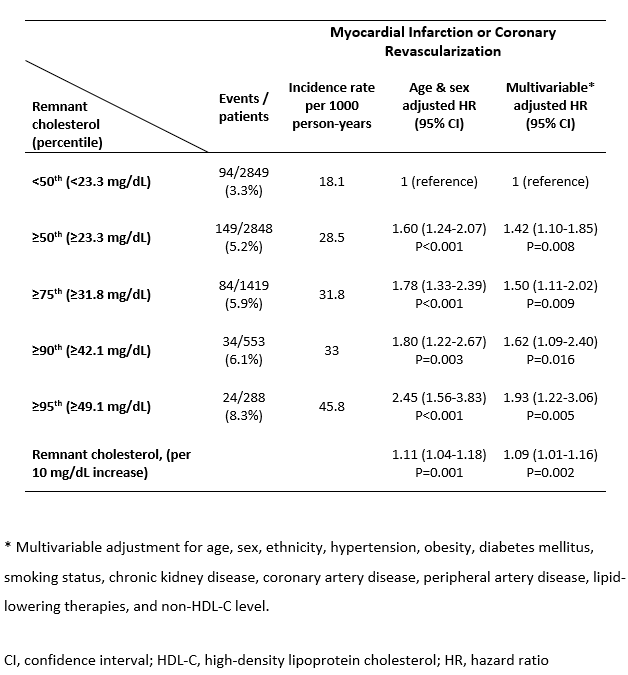
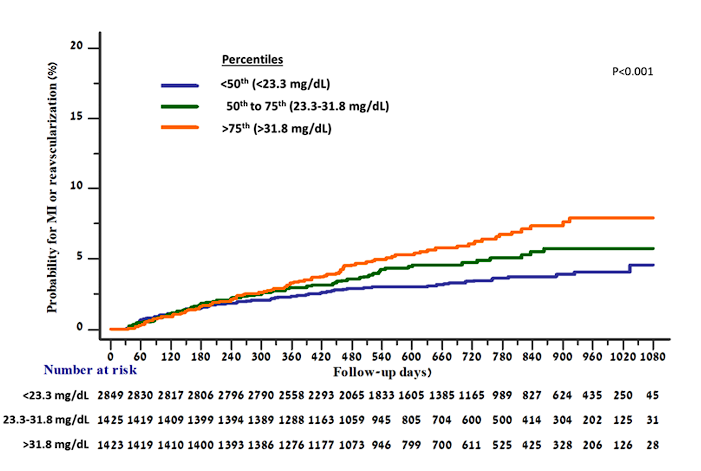
Results: Mean age was 69 ±10 years; 78% were treated by lipid-lowering therapies. During median follow-up of 22 months, a first event of MI or coronary revascularization occurred in 243 patients (4.3%). After multivariable adjustment including lipid-lowering therapies and non-HDL-C, RC was associated with higher MI or revascularization risk: hazard ratio (95% confidence interval): 1.42 (1.10-1.85), 1.50 (1.11-2.02), 1.62 (1.09-2.40), and 1.93 (1.22-3.06), in those with RC percentiles ≥50th (23.3 mg/dL), ≥75th (31.8 mg/dL), ≥90th (42.1 mg/dL) and ≥95th (49.1 mg/dL), compared to RC <50th percentile. When RC and non- HDL-C were discordant, the level of RC better reflected higher risk for adverse cardiac event.
Conclusions: Elevated RC is a risk factor for MI or revascularization following an ischemic stroke, independent of lipid-lowering therapies and non-HDL-C, and may serve as a residual cardiovascular risk marker and potential treatment target in patients with ischemic stroke.
Key words: Lipids; Remnant cholesterol; Low-density lipoprotein; Myocardial infarction; Coronary revascularization; Ischemic stroke
israelheart@ortra.com מייל לשאלות
