
Transcatheter Aortic Valve Implantation in Small and Very small Aortic Valve Annuli: A propensity-matched analysis between self-expanding versus balloon-expandable valves
2Cardiology, Chaim Sheba Medical Center, Israel
3Cardiology Department, Hadassah Medical Center, Israel
4Cardiology Department, Rabin Medical Center, Israel
5Cardiology Department, Sha'arei Zedek Medical Center, Israel
Background: The management of Transcatheter Aortic Valve Implantation (TAVI) patients with a small aortic annulus (SAA) increases the risk of patient- prosthesis mismatch and overall mortality.
Aim: Compare the hemodynamic and clinical outcomes of transcatheter balloon-expandable valve (BEV) versus transcatheter self-expandable valve (SEV) in SAA.
Methods: A propensity score matching (PSM) of severe AS patients with SAA who underwent trans-femoral TAVR and enrolled to the Israeli TAVR registry between the years 2008-2023. Small aortic annulus was defined as aortic-valve annulus area≤430 mm2. Since the BEV used have a smaller size cut-off, an additional analysis on very small aortic annulus (vSAA) as defined as aortic-valve annulus area≤345 mm2 was performed.
Results: 1364 consecutive patients with SAA (BEV n=485; SEV n=879), mean age of 82±7 years, of whom the vast majority were female (83%). Propensity matched groups comprised of 329 and 122 paired for the SAA and vSAA patients, respectively. As compared to BEV in the SAA and vSAA analyses, SEV showed lower rates of post-procedural of LBBB (32% vs. 22%, and 41% vs. 22%; both p<0.01, respectively), however higher rates of major vascular complications (2% vs. 7%, and 2% vs. 12%; both p<0.01, respectively) and major or life-threatening bleeding but only in vSAA group (17% vs. 9.1%, p=0.009). One-month mortality was higher in the SEV vs. BEV in both SAA and vSAA comparisons (2% vs. 0.6%, p=0.048; and 3% vs. 0%, p=0.018; respectively). A non-significant trend of higher 5-year mortality was observed in univariate models, noted mainly in vSAA patients (22% vs. 19%, p=0.385; 24% vs 15%, p=0.073).
Conclusions: The present analysis observed higher rates of major vascular complications and 1-month mortality in SAA and vSAA treated with SEV. A similar non-significant trend towards long-term mortality for the vSAA group was observed and should be evaluated in larger cohorts.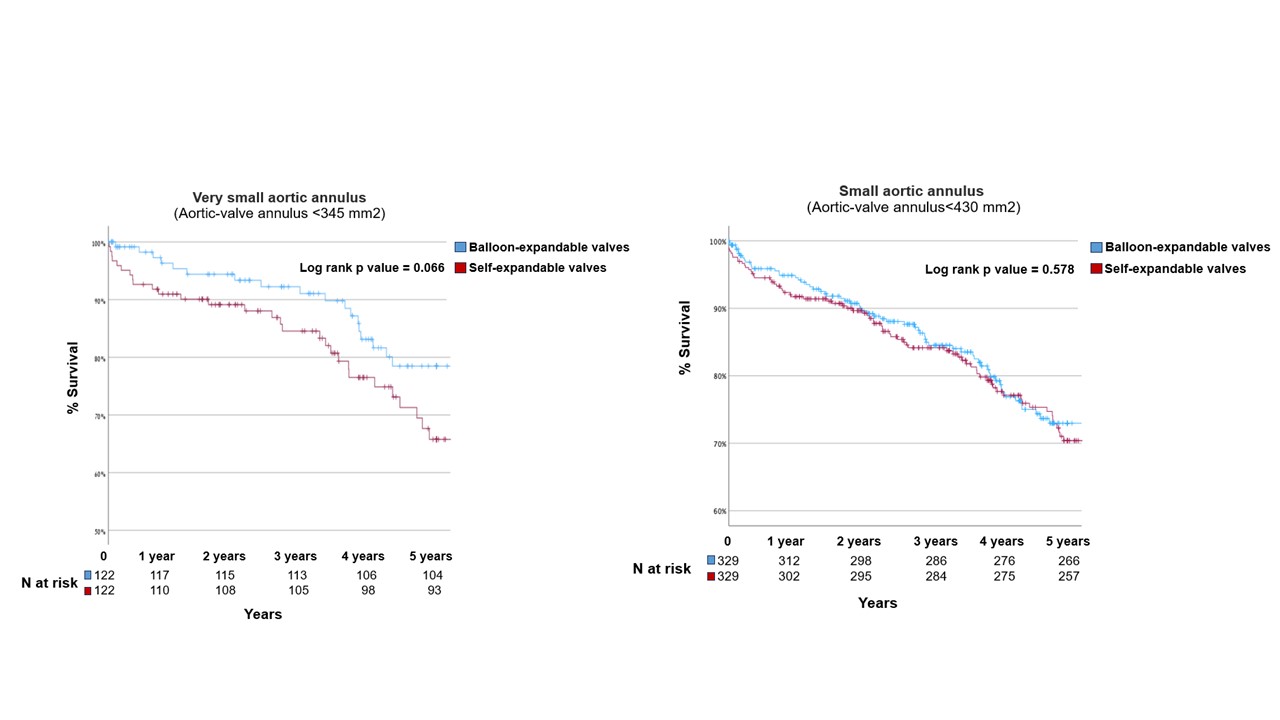
israelheart@ortra.com מייל לשאלות
