
Impact of Atrial Fibrillation and Mitral Regurgitation Mechanism on TEER Results: New Results
2Department of Military Medicine, Hebrew University of Jerusalem, Tzameret Program, Israel
3Department of Cardiology, Barzilai Medical Center, the Ben-Gurion University of the Negev, Israel
Introduction
Both mitral regurgitation (MR) and atrial fibrillation (AF) are common diseases. MR can be classified by its underlying mechanism as degenerative MR (DMR), atrial FMR (aFMR) or ventricular FMR (vFMR). TEER (Transcatheter Edge to Edge Repair) is an established technique for the treatment of MR in patients considered at high surgical risk.
Material and method
An observational retrospective study including patients who underwent TEER for MR at Shaare Zedek Medical Center (January 2020-November 2022). The patients were categorized into three groups based on the MR mechanism (DMR, aFMR, vFMR). Primary endpoints were event-free survival (HF hospitalization or mortality) and overall survival. Multivariate Cox regression was used to adjust for possible confounders.
Results and discussion
221 patients were included in this study, with an average age of 75.8 years old, among them 91 females (44%). 109 patients (49.3%) had AF whereas 144 patients (65%) suffered from functional MR. On average, patients with vFMR were younger compared to other MR mechanisms.
Patients with AF had a worse prognosis compared to those without AF(p=0.027), and FMR patients had a worse prognosis compared to DMR patients(p=0.016). In the DMR group only, patients with paroxysmal atrial fibrillation exhibited a worse prognosis compared to those without AF or with chronic AF(p=0.011). MR mechanism and AF status divides the cohort into 5 groups, with significant differences in the survival curves(p=0.044).
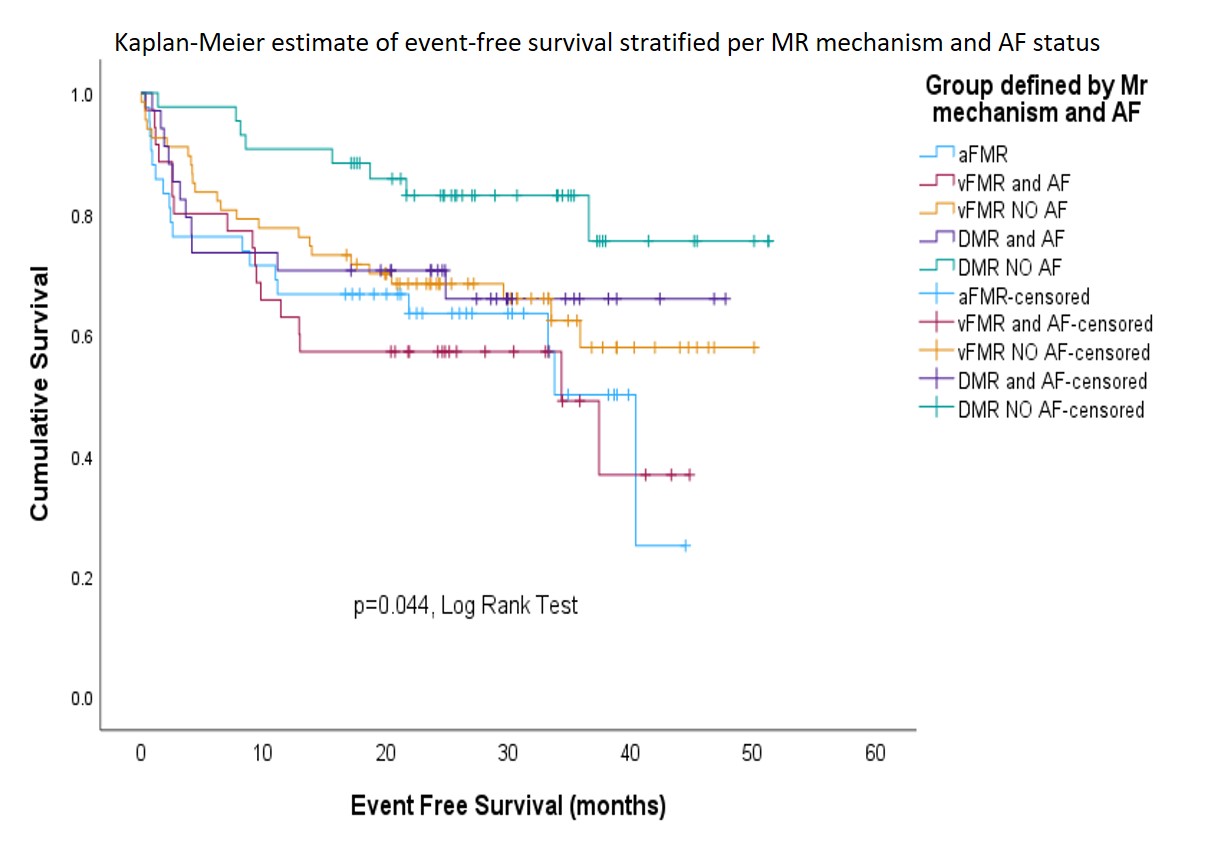
Multivariate analysis showed statistically significant factors: COPD(p=0.023) and MR mechanism(p=0.048) for event-free survival, and COPD(p=0.001) and diabetes mellitus(p=0.005) for overall survival.
Echocardiographically, there was a reduction in MR grade following the procedure; however, there was no significant difference in the extent of MR grade reduction between the MR mechanism groups(p=0.618). Postprocedural mean mitral valve gradient was highest in the aFMR group(p=0.002).
Conclusion
Patients with AF undergoing TEER have worse prognosis, particularly those that have FMR.
israelheart@ortra.com מייל לשאלות
