
Novel Epigenetic Mapping in Cell-Free DNA for Detection of Changes During Sodium-Glucose Cotransporter 2 Inhibitors (SGLT2I) Treatment in Heart Failure Patients
2School of Chemistry, Tel Aviv University, Israel
Background: Sodium-Glucose Cotransporter-2-Inhibitors (SGLT2i) have demonstrated unexpectedly beneficial effects on cardiovascular outcomes, particularly in patients with heart failure (HF) regardless of ejection fraction (EF). While the precise molecular mechanisms underlying their cardioprotective effects remain unclear, one hypothesis is their potential to induce epigenetic changes, thereby influencing gene regulation. To explore this, we examined whether SGLT2i treatment modulates epigenetic modification in patients with HF.
Methods: We conducted a prospective study of HF patients receiving guideline-directed medical therapy. Using a novel approach, we analyzed the genomic distribution of 5-methylcytosine (5mC) in cell-free DNA (cfDNA) extracted from plasma to identify loci with differential epigenetic signatures. Epigenetic markers were fluorescently labeled through a chemo-enzymatic process and hybridized onto a custom microarray, where fluorescent signals reflected the epigenetic content of specific DNA sequences. A machine learning algorithm identified a panel of biomarkers distinguishing the epigenetic effects of SGLT2i and differentiating according to clinical response, which was assessed using BNP levels, NYHA classification, 6-minute walking tests, and the Kansas City Cardiomyopathy Questionnaire.
Results: We recruited 34 HF patients (NYHA class II–III) before initiating SGLT2 inhibitor therapy. The mean age was 70 (±11) years, 41% were women, the mean EF was 49% (±13), and 74% had non-ischemic cardiomyopathy. After three months of treatment, substantial epigenetic changes were identified. Figures 1 and 2 highlight the top 200 differential methylation markers. Cell-specific methylation signatures successfully differentiated patients based on their clinical treatment response. Notably, significant methylation changes were observed in genes with established roles in cardiovascular disease, including ADCY6, MPST, NFATC1, and PPP1CA.
Conclusion: Analysis of cfDNA revealed significant DNA methylation changes in cardiovascular-related genes following SGLT2i treatment, with variations linked to therapeutic response. These epigenetic modifications shed light on the mechanisms underlying the cardioprotective effects of SGLT2i and identifying potential biomarkers of therapeutic response in HF patients.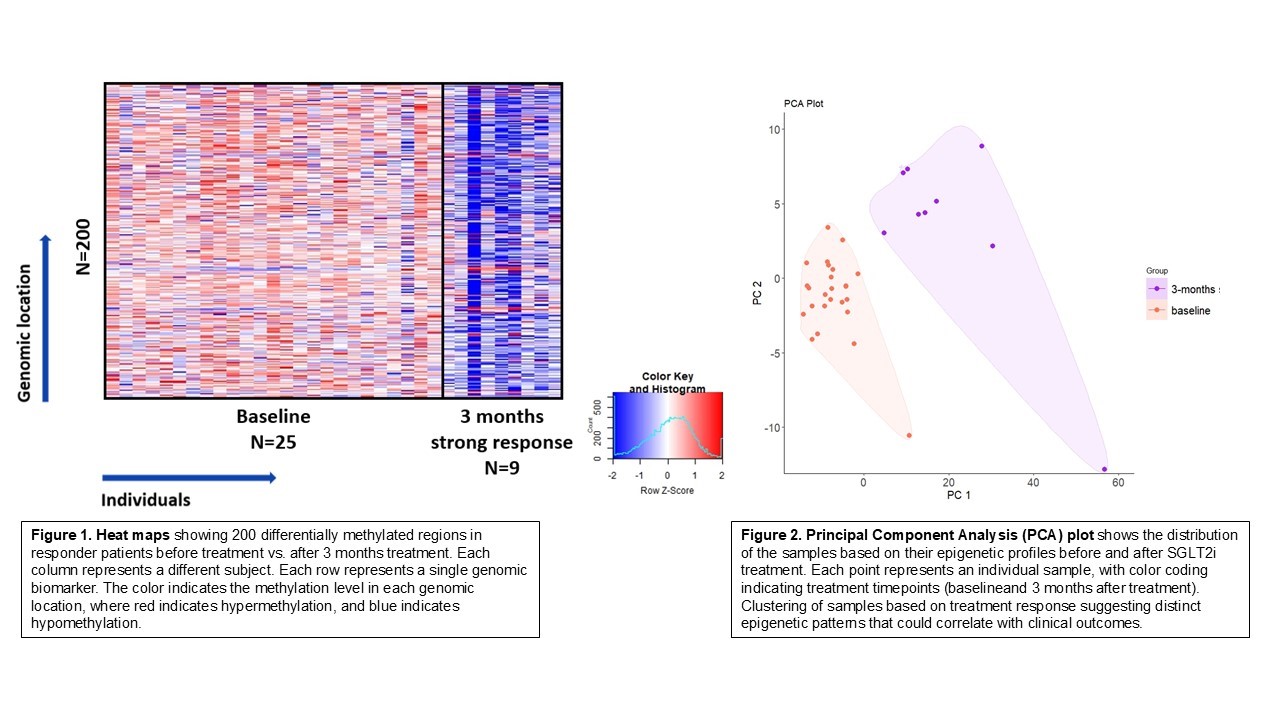
israelheart@ortra.com מייל לשאלות
