
AI assisted bedside echocardiography for clinical decision making
2Internal Medicine B, Tel-Aviv Sourasky Medical Center affiliated to the Faculty of Medicine, Tel-Aviv University, Israel
3Internal Medicine T, Tel-Aviv Sourasky Medical Center affiliated to the Faculty of Medicine, Tel-Aviv University, Israel
Introduction- Bedside cardiac Point-of-care ultrasound (POCUS) can yield valuable information for decision-making. However, it is limited by the high skill required to acquire and interpret high-quality images. Machine learning can help mitigate this gap by providing assistance for optimal image acquisition and AI-based interpretation suited for bedside evaluation. We aimed to evaluate the impact of AI-assisted, FDA-cleared cardiac POCUS on clinical decision-making.
Methods- This was a prospective crossover study. During the first 2 months, internal medicine physicians with no formal ultrasound training used cardiac POCUS as a complementary tool for their bedside patient evaluation. Then, during the following 4 months, an AI cloud-based platform (AISAP-POCAD™, Ramat Gan, Israel) was added to provide AI-based cardiac POCUS diagnostic support regarding LVEF, RVEF, effusion, IVC, and valve assessment. The physicians reported any new findings, and any changes made to the treatment plan as a direct result of their bedside POCUS.
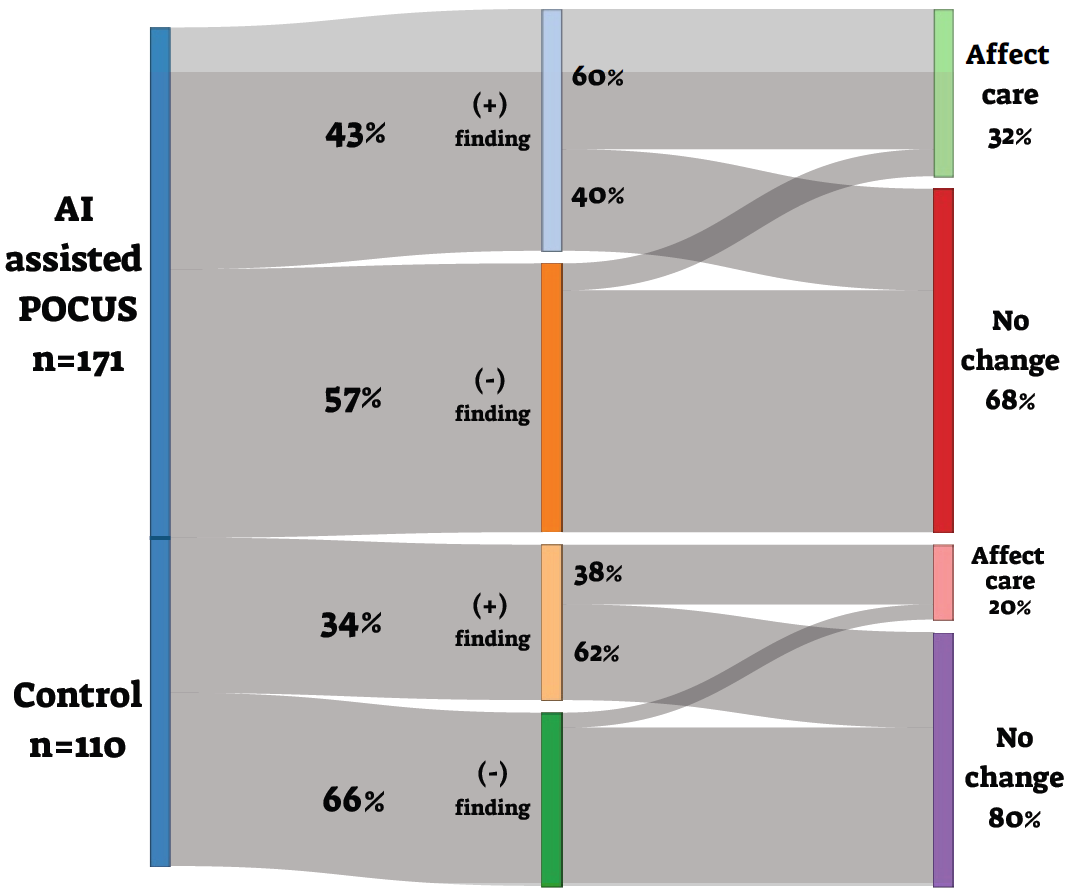
Results-A total of 281 admitted patients underwent cardiac POCUS performed by 8 physicians. Of these, the first 110 (39%) exams were performed without AI assistance (control) and the following 171 (61%) used the AI-assisted platform. Baseline characteristics were similar between the groups. The most common reasons for POCUS were worsening dyspnea (50%) and chest pain (20%). New cardiac POCUS findings were detected in 40% of the exams, with a trend towards the AI group (43% vs.34%, p=0.11). A change in the treatment plan occurred more often in the AI group (32% vs. 20%, p=0.033). In multivariate analysis, AI assistance was an independent predictor for POCUS-led change of care in the entire cohort (adjusted OR 2.05, 95% CI 1.15-3.85), and in the subgroup of cases with new echocardiographic findings (adjusted OR 2.55, 95% CI 1.05-6.20).
Conclusion- Using AI-assisted POCUS led to a higher rate of treatment plan changes, suggesting improved imaging and operator confidence.
israelheart@ortra.com מייל לשאלות
